
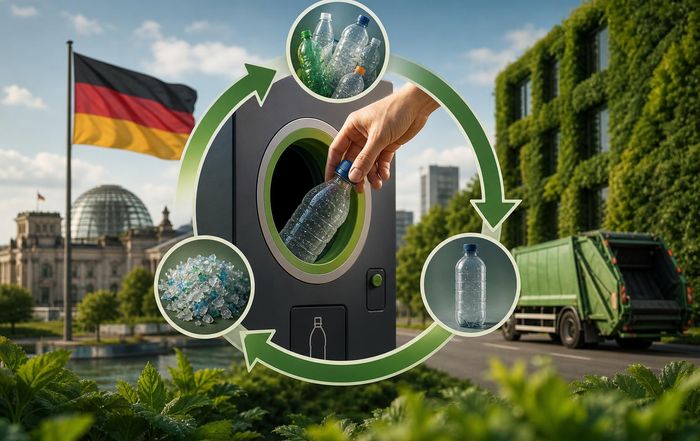
How Germany's Deposit Return System Powers High-Quality Plastic Collection
Germany is often cited as a world leader in recycling, and its deposit return system for drink containers is a big reason why. Known domestically as the Pfand system, it has helped the country achieve some of the highest collection and recycling rates for beverage packaging anywhere in the world, while cutting litter and supporting a broader shift toward a circular economy.
This fab feature looks at how the system actually works, what it achieves for plastic collection in particular, where it falls short, and what other countries can realistically learn from it.
How the German "Pfand" System Works in Practice
Germany's modern deposit return system (DRS) for drinks packaging is rooted in national packaging legislation dating back to the early 1990s, but the decisive change came with the mandatory one-way deposit on single-use beverage containers introduced in 2003 under the Packaging Ordinance. Today it is embedded in the German Packaging Act (Verpackungsgesetz), which sets the legal framework for who participates, which containers carry a deposit, and how the money flows.
Most single-use plastic bottles and cans for soft drinks, water, and beer carry a €0.25 deposit, clearly marked with a standardized logo. Reusable glass and some reusable plastic bottles carry a lower deposit, typically €0.08-€0.15, to encourage refilling. Consumers pay this deposit at the point of sale and get it back when they return the empty container to a shop, supermarket, or other collection point. The widespread presence of automated reverse vending machines-particularly in supermarkets-makes returning empties part of everyday life rather than a special trip.
Behind the scenes, producers and retailers participate in a nationwide clearing system that reconciles deposits, manages logistics, and ensures containers are properly sorted and sent to recyclers. This infrastructure is overseen by organizations such as Deutsche Pfandsystem GmbH (DPG), which coordinates the one-way deposit system, and it operates alongside the country's extended producer responsibility schemes for packaging more broadly. Germany's approach is aligned with EU-wide requirements under the EU Single-Use Plastics Directive, which sets collection and recycled-content targets for plastic beverage bottles, and is monitored by authorities such as the European Commission and the German Environment Agency (UBA).
Why It Delivers Exceptionally High Plastic Collection Rates
Germany's deposit return system matters for plastic because it delivers not just high collection, but high-quality, source-separated plastic that can be effectively recycled into new products and, increasingly, new bottles.
Official German and EU sources consistently report that collection rates for PET beverage bottles in Germany are in the mid- to high-90% range, far above the EU's minimum collection target of 77% by 2025 and 90% by 2029 for plastic beverage bottles. This performance is comparable to other deposit-based systems in countries such as the Nordic states, where similar approaches have been in place for decades. By contrast, many countries that rely primarily on curbside collection without deposits struggle to reach much above 50-60% collection rates for plastic bottles, and the material they collect is often more contaminated.
The key driver is the financial incentive combined with convenience. A €0.25 deposit is enough to feel meaningful, especially when multiplied across multiple bottles, and the fact that containers can be returned at the same place where people buy their groceries removes friction. In addition, unredeemed deposits-when people fail to bring containers back-stay within the system and help fund operations, reducing the need for public subsidies. This creates a self-reinforcing loop: strong incentives lead to high return rates, which generate cleaner material streams, which in turn make recycling economically viable and attractive for industry.
Because the containers are collected separately from mixed household waste, the resulting PET and other plastics are relatively clean and homogeneous. This significantly improves the efficiency of recycling processes and supports the production of "bottle-to-bottle" recycled PET that meets strict food-contact standards under EU rules overseen by authorities such as the European Food Safety Authority (EFSA). For a global audience concerned with plastic recycling, this combination of high capture rates and high material quality is one of the most important features of the German system.
For readers interested in how this fits into everyday choices, this performance directly supports sustainable living by making it easier for consumers to ensure their drink containers actually get recycled, rather than just placed in a bin and hoped for the best. It also ties closely to broader discussions of waste and innovation covered in more depth on our sustainable living and waste pages.
Design Features That Make the System Effective
The success of Germany's deposit return system is not accidental; it rests on specific design choices that other countries considering similar schemes can study.
One crucial element is the level of the deposit. Research by organizations such as the Ellen MacArthur Foundation and policy work by the OECD highlight that low deposits tend to lead to lower return rates. Germany's relatively high €0.25 for one-way containers sends a clear price signal. It is large enough that most consumers notice when they do not get it back, and it is also large enough to motivate informal collection by people who pick up littered bottles and cans.
Another important feature is broad coverage and clear rules. Over time, Germany has expanded the range of beverages and containers that fall under the deposit system, reducing loopholes that once allowed some drinks (like certain juices or alcoholic mixed drinks) to avoid deposits. Although not every container type is covered, the system now includes the majority of high-volume, on-the-go plastic beverage packaging. This matters because partial coverage can confuse consumers and undermine trust. The German approach of clear labeling and standardized logos helps people quickly see which containers carry a deposit.
The system also benefits from retailer participation obligations. Larger shops that sell deposit-bearing beverages are generally required to take them back, at least for the brands and types they sell. Many go further and accept a wide range of containers, which is especially visible in large supermarkets and discount chains. This obligation, combined with reverse vending technology, underpins the convenience that is essential to high return rates.
From a sustainable business perspective, the system is a classic example of extended producer responsibility: producers and distributors of beverage packaging must register, participate financially, and meet specific obligations. This aligns with broader EU waste and packaging directives and is monitored by national and EU-level environmental authorities such as the European Environment Agency (EEA). Companies that operate in multiple European markets increasingly see high-performing deposit systems as part of their strategy to meet corporate sustainability targets, particularly commitments related to recycled content and circular packaging.
For readers exploring how policy and business interact in the green transition, this intersection is discussed more broadly on our sustainable business and business sections.
Environmental Benefits: From Litter Reduction to Climate Impact
The most visible impact of Germany's deposit system is the reduction in littered bottles and cans. Because each container has a cash value, very few are left lying in parks, city streets, or along roadsides; if the original purchaser does not return it, someone else often will. This has been observed not only in Germany but in other countries with deposit systems, and is reflected in litter surveys cited by organizations such as Zero Waste Europe and Reloop.
Less visible but equally important are the climate benefits. Producing plastic from virgin fossil fuels is energy-intensive and generates greenhouse gas emissions. When high-quality PET from deposit systems is recycled back into new bottles, it can significantly reduce the carbon footprint of beverage packaging. Life-cycle assessments referenced by bodies such as the United Nations Environment Programme (UNEP) and the International Energy Agency (IEA) show that using recycled plastics typically requires far less energy than producing virgin material, especially when combined with decarbonizing electricity grids.
Germany's deposit system is therefore not just a waste-management tool; it is also a climate policy instrument, contributing to emissions reductions in the packaging sector. This aligns with the country's broader efforts to meet climate targets under the Paris Agreement, and with EU strategies such as the European Green Deal and the Circular Economy Action Plan. For readers interested in the bigger picture of climate change and circular economies, these links are explored further in our climate change and global coverage.
Another environmental benefit is the reduced demand for virgin plastic. As beverage brands incorporate more recycled PET into their bottles-driven in part by EU requirements for minimum recycled content-high-quality feedstock from deposit systems becomes increasingly valuable. This, in turn, can help stabilize recycling markets, making it more attractive for companies to invest in advanced sorting and reprocessing technologies. The German system's scale and consistency provide a reliable supply of material that supports these investments.
Social and Economic Dimensions: Who Pays and Who Benefits?
No deposit system is free, and Germany's model raises important questions about who bears the costs and who captures the benefits. The operating expenses of the system-including reverse vending machines, logistics, sorting, and administration-are financed through a combination of producer fees, retailer participation, and revenues from unclaimed deposits and material sales.
Consumers pre-finance the system when they pay the deposit, but as long as they return the containers, they get that money back. For those who regularly redeem deposits, the system functions more like a temporary loan than a tax. However, some people-especially those with lower incomes or less time-may be less likely to return all containers, effectively turning their unclaimed deposits into a hidden contribution to the system's finances. This has led to discussions in Germany and elsewhere about the equity implications of deposit systems, especially for people with disabilities, older adults, or those without easy access to return points.
On the benefit side, the system creates and supports jobs in logistics, maintenance, and recycling, and it can provide informal income opportunities for people who collect discarded bottles. It also reduces the burden on municipal waste services by diverting high-volume beverage containers out of household bins and public litter streams. Municipalities may save on street-cleaning and waste-disposal costs, although the exact balance of costs and savings varies and is sometimes contested in policy debates.
For businesses, especially beverage producers and retailers, the system can be both a cost and an opportunity. Compliance requires investment and ongoing fees, but participation also allows companies to position themselves as part of the solution to plastic pollution and to secure access to high-quality recycled material. Many multinational brands use Germany as a key market for piloting innovation in circular packaging, including bottle-to-bottle recycling and refillable systems, which can be followed in our innovation and technology sections.
International organizations such as the World Bank and the OECD have highlighted deposit systems as one of several policy tools that can help countries move toward circular economies, but they also stress the need for careful design to avoid disproportionate impacts on small retailers or low-income consumers. Germany's experience illustrates both the potential and the need for ongoing refinement.
Limitations, Criticisms, and Ongoing Debates
Despite its strengths, Germany's deposit return system is not without criticisms and gaps. One recurring concern is that the focus on beverage containers can give a misleading impression that the plastic problem is "solved," while many other types of plastic packaging-such as films, trays, and multi-layer pouches-remain difficult to collect and recycle effectively. Environmental groups including Greenpeace and Friends of the Earth Europe have warned that high recycling rates for bottles should not distract from the need to reduce overall plastic consumption, especially single-use items.
Another issue is complexity and confusion. Although labeling has improved, some consumers still find it difficult to know which containers are deposit-bearing and which are not, especially when traveling or buying niche products. The coexistence of deposit-bearing single-use containers and non-deposit packaging, alongside separate systems for reusable bottles, can be confusing. Over time, Germany has tried to simplify rules and expand coverage, but debates continue about whether to include additional container types, such as certain milk drinks or more juice categories.
There are also practical challenges for small retailers, who may lack the space or resources for automated machines and must sometimes handle returns manually. While policy measures and financial support aim to ease this burden, trade associations have at times argued that the system's requirements can be onerous for small shops, particularly in rural areas.
From a broader environmental awareness perspective, critics point out that even the best recycling system does not eliminate the environmental impacts of producing, transporting, and cooling beverages, nor does it address issues such as microplastics or the impact of plastic production on petrochemical expansion. Organizations such as Break Free From Plastic argue that deposit systems should be paired with strong measures to promote reuse and refill, including standardized bottles and packaging-free retail models. Germany already has a long tradition of refillable beer and mineral water bottles, but the share of refillables has fluctuated, and campaigners want stronger policy support for these systems.
These debates mirror wider global discussions on how far recycling can take us versus how much we must change production and consumption patterns-a theme that cuts across our environmental awareness and lifestyle coverage.
Lessons for Other Countries Considering Deposit Systems
As more countries and regions-from parts of Europe and North America to Asia and beyond-consider or implement deposit return systems, Germany's experience offers practical lessons rather than a simple blueprint to copy.
First, deposit systems work best when they are integrated into a broader waste and circular-economy strategy, rather than treated as a standalone fix. Germany's system sits alongside curbside collection, producer responsibility schemes for other packaging, and policies to encourage reusable containers. International bodies such as the United Nations Environment Assembly (UNEA), which is negotiating a global plastics treaty, emphasize that tackling plastic pollution requires a suite of measures, from product design and reuse to recycling and safe disposal.
Second, context matters. Germany's dense retail network, strong administrative capacity, and public trust in environmental regulation all support the success of its deposit system. Countries with different geographies, informal economies, or governance structures may need to adapt the model, for example by involving cooperatives of waste pickers, using mobile collection points, or tailoring deposit levels to local income levels and price sensitivities.
Third, clear communication and public engagement are vital. In Germany, the concept of Pfand is deeply embedded in culture; people grow up knowing that bottles have a value and that returning them is normal. Countries introducing new systems may need sustained public information campaigns, school programs, and visible branding to build similar habits. This is an area where partnerships with NGOs, community groups, and educational institutions-such as those highlighted by UNESCO in its work on education for sustainable development-can play a crucial role.
For policy-makers, businesses, and citizens interested in how these design choices can support sustainable living and sustainable business models, Germany's system is a powerful case study that connects regulation, infrastructure, and everyday behavior. It also illustrates how domestic policy can support global goals, from reducing marine litter to cutting greenhouse gas emissions, topics we explore further across our economy and education pages.
What It Means for People Trying to Live More Sustainably
For individuals in Germany, the deposit system turns what could be a passive act of "throwing something away" into a small but tangible participation in a circular loop. Returning bottles becomes part of routine shopping, and the visible refund on receipts reinforces the idea that packaging has value, not just as waste but as a resource.
For people living elsewhere, the German example suggests several takeaways:
Infrastructure and incentives matter. Personal commitment is important, but systems that make the sustainable choice easy and rewarding are far more effective than relying on goodwill alone.
Quality of recycling counts. Source-separated, deposit-collected plastics have a much better chance of becoming new bottles than mixed plastics from general waste streams. When possible, choosing products in packaging that is part of a robust collection and recycling system can make a real difference.
Recycling is necessary but not sufficient. Even in Germany, with its high collection rates, the bigger environmental gains will come from combining effective recycling with waste reduction, reuse, and better product design-themes that run through our plastic recycling and design coverage.
In the end, Germany's deposit return system shows how well-designed policy can mobilize everyday habits to support plastic collection and circularity at scale. It is not a complete answer to the plastic problem, but it is a powerful piece of the puzzle-one that many countries are now examining closely as they search for ways to save resources, cut pollution, and build more sustainable economies.
