
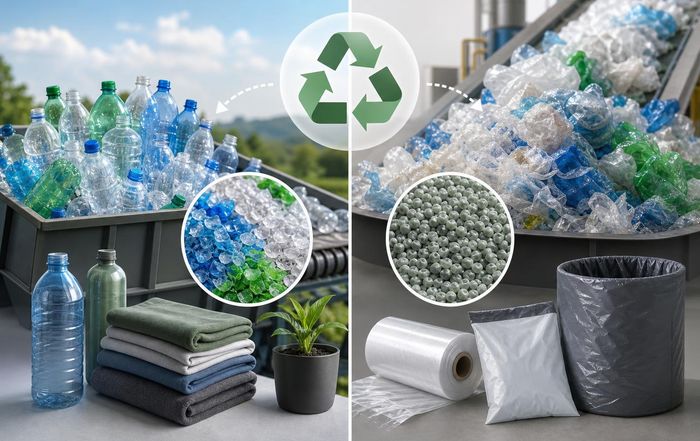
How Plastic Film Recycling Really Differs From Bottle Recycling
Plastic bags, wrap, and packaging film are everywhere, yet most household recycling systems were built around rigid containers like bottles and tubs. That mismatch is at the heart of why so much plastic film still ends up in landfills, incinerators, or the environment, even in places with well-developed recycling systems.
Understanding how plastic film recycling differs from bottle recycling helps explain confusing "store drop-off only" labels, why many curbside programs reject bags, and what needs to change for a more circular plastics economy.
This page looks at the materials, technology, economics, and policy behind both systems-and what individuals, businesses, and policymakers can realistically do next.
Different plastics, different problems: film vs. bottles
Although both are "plastic," bottles and films are designed, used, and handled very differently. Those differences cascade through the entire recycling chain-from collection to re-manufacturing.
Most beverage bottles are made from polyethylene terephthalate (PET, #1), while many household product bottles and jugs use high-density polyethylene (HDPE, #2). These rigid plastics have relatively consistent shapes and resin grades, making them easier for automated systems to recognize, sort, and process. PET and HDPE bottles also tend to be relatively clean, high-value items that recycling facilities actively seek.
Plastic films, by contrast, are a sprawling category. They include lightweight carrier bags, bread and produce bags, pallet wrap, mailing envelopes, bubble wrap, shrink wrap on multipacks, and thin liners in many forms of packaging. The most common resins are low-density polyethylene (LDPE, #4) and linear low-density polyethylene (LLDPE), but films can also contain polypropylene (PP, #5), multi-layer laminates that mix plastics with aluminum or paper, and a growing number of "compostable" or "bioplastic" films. This diversity of materials, thicknesses, and additives makes uniform recycling much harder.
For bottles, recycling systems can often rely on resin identification codes (#1, #2) and standardized shapes to sort material into relatively pure streams. Film recyclers, when they exist, must cope with a jumble of formats, inks, glues, labels, zippers, and contamination from food or dirt. That is one reason many municipal programs still tell residents to keep plastic bags and wrap out of the bin, even when they accept bottles and tubs.
Readers who want to dive deeper into different plastics and their impacts can also explore our dedicated page on plastic recycling, which looks more broadly at resin types and recycling challenges.
Collection systems: curbside bins vs. store drop-off
Perhaps the most visible difference between plastic film and bottle recycling is how material is collected. In much of North America and Europe, bottles are routinely accepted in curbside or communal recycling systems. Residents place them in household bins, where they are collected alongside paper, metal, and other rigid plastics. Some regions also use container deposit schemes, where consumers pay a small deposit and get it back when they return bottles to designated machines or centers. Both approaches create relatively clean, concentrated streams of PET and HDPE.
Plastic films rarely enjoy this kind of integration. Because they are light, flexible, and prone to tangling in sorting equipment, most curbside programs exclude them. Instead, limited film collection often happens through retail store drop-off points-bins near supermarket entrances where customers can return carrier bags and sometimes other clean films. These voluntary take-back programs can work reasonably well for high-volume items like grocery bags, but participation is uneven and heavily dependent on consumer effort.
In some countries and cities, pilot programs are experimenting with curbside film collection, often in separate bags or streams to reduce equipment jams. However, these initiatives are still far from universal and often face higher contamination rates. Where they do exist, education and clear communication are crucial, a theme that also runs through broader environmental awareness efforts.
Globally, organizations such as the UN Environment Programme (UNEP), OECD (https://www.oecd.org/), and national agencies like the US Environmental Protection Agency (EPA) and the European Environment Agency (EEA) have highlighted the need to redesign collection systems to capture more flexible plastics, but implementation remains patchy.
Sorting and processing: why films jam the system
Once collected, bottles and films take very different paths through recycling facilities.
Bottles typically enter a materials recovery facility (MRF) designed for mixed recyclables. Here, a series of conveyors, screens, magnets, eddy current separators, optical sorters, and manual pickers separate materials by type. PET bottles, for instance, may be identified by near-infrared (NIR) sensors and air jets, then baled and sent to specialized plants. There, they are shredded into flakes, washed, separated by density, and further purified before being re-melted or chemically recycled into new products.
These systems are not perfect, but they are relatively mature. Standardized bottle shapes and densities help equipment distinguish PET from HDPE or other plastics. Deposit systems further improve quality by returning intact, clean bottles.
Plastic films behave quite differently on the same equipment. Their light weight and flexibility cause them to wrap around rotating screens, clog belts, and interfere with optical sorters-forcing facilities to shut down lines for manual cutting and cleaning. Many MRF operators view films as a contaminant that raises costs and safety risks, rather than a target material.
Dedicated film recycling facilities exist, particularly for post-industrial waste such as agricultural film, pallet wrap, and manufacturing offcuts. These streams are usually cleaner and more homogeneous than household film waste. They can be shredded, washed, and pelletized into recycled polyethylene (rPE) that becomes trash bags, construction film, composite lumber, or other products.
However, moving from primarily industrial feedstocks to post-consumer films collected from households remains a major technical and economic challenge. Mixed resins, food residues, paper labels, and multi-layer laminates all reduce the quality and yield of recycled pellets. Industry groups like the Association of Plastic Recyclers (https://plasticsrecycling.org/) and Plastics Europe (https://plasticseurope.org/) are working on design guidelines and process improvements, but widespread, high-quality film recycling is still in development.
For readers interested in how technology can support more sustainable systems, our innovation and technology pages explore related breakthroughs beyond plastics alone.
Contamination and quality: why "clean and dry" matters more for film
All recycling systems struggle with contamination, but films are especially vulnerable. Bottles are relatively robust: labels and caps can often be removed during washing, and minor food or drink residues are usually manageable in modern PET and HDPE recycling lines. While contamination still reduces value, many bottle recyclers have built processes to cope with realistic levels of dirt and residual liquids.
Films, however, have a much higher surface-area-to-weight ratio and a tendency to cling to whatever they touch. Food residues, oils, and moisture adhere easily, and thin films can tear or fragment during handling, creating micro-contaminants that spread through a batch. Paper labels and tape stuck to film can disintegrate into pulp in washing systems, making separation harder. Even small amounts of incompatible plastics or metals (such as staples) can cause quality problems in the final pellets.
This is why most store drop-off schemes and film recyclers stress that material must be clean and dry and usually restrict accepted items to certain types of polyethylene film. Multi-layer snack bags, "crinkly" films, and pouches with metalized layers are commonly excluded. When unsuitable materials slip through, they can downgrade entire loads, making buyers reluctant to pay for post-consumer film bales.
By contrast, PET bottle recycling has benefited from decades of investment in food-grade recycling technologies, supported by regulators like the European Food Safety Authority (EFSA) and the US Food and Drug Administration (FDA), which evaluate processes for safety in food contact applications. Similar regulatory frameworks for food-grade recycled films are only starting to emerge, and technical barriers remain higher.
This quality gap has direct implications for sustainable living choices. Putting the wrong films into recycling streams can do more harm than good, a point we also emphasize on our sustainable living hub, which looks at how small daily decisions add up.
End markets and economics: bottles have buyers, films often don't
Recycling only works when there are stable end markets for the materials produced. Here, bottles and films diverge sharply.
Recycled PET (rPET) and recycled HDPE (rHDPE) have relatively strong demand. rPET is widely used in textiles (fleece, polyester clothing, carpets), strapping, and increasingly back into bottles and food packaging. rHDPE is used in pipes, non-food bottles, crates, and other durable goods. Regulations and voluntary commitments-such as minimum recycled content mandates in the EU and corporate pledges tracked by initiatives like the Ellen MacArthur Foundation (https://ellenmacarthurfoundation.org/)-have further boosted demand for high-quality rPET and rHDPE.
Plastic films, especially post-consumer films, have more limited and lower-value markets. Recycled polyethylene from films often goes into trash bags, construction sheeting, agricultural film, and composite lumber. Many of these applications are downcycling, where the material moves into products that are harder or impossible to recycle again. While there is growing interest in incorporating recycled film content into new flexible packaging, technical issues around clarity, strength, odor, and food safety make this challenging.
The economics are also less favorable. Collecting, sorting, and washing lightweight films is expensive per kilogram of material recovered, especially when contamination is high and yields are low. Virgin polyethylene prices, influenced by global fossil fuel markets, often undercut the cost of producing high-quality recycled film pellets. Without supportive policies-such as recycled content requirements, extended producer responsibility (EPR) schemes, or landfill/incineration taxes-film recycling businesses can struggle to remain viable.
Bottles, by contrast, often benefit from deposit-return systems, EPR schemes, and brand-driven demand for recycled content. These mechanisms help stabilize prices and encourage investment. As a result, bottle recycling infrastructure is more developed, and per-unit economics are often more attractive.
These market realities are central to broader debates on climate change and the circular economy, because without viable end uses, plastics are more likely to be landfilled, burned, or leaked into the environment, contributing to greenhouse gas emissions and pollution.
Design for recycling: bottles are ahead, films are catching up
One of the most significant differences between bottle and film recycling lies in how products are designed. Bottle manufacturers have been working with recyclers and standard-setting bodies for years to improve recyclability, leading to guidelines on label types, color choices, and closure materials. For example, clear PET bottles without heavy colorants are preferred because they can be turned into a wider range of new products.
Plastic films are only beginning to undergo a similar design transformation. Many flexible packages today are multi-layer laminates that combine several plastics (such as PET, PE, and nylon) with aluminum or paper to achieve barrier properties, printability, and strength. These structures are extremely difficult, if not impossible, to recycle at scale with current technologies, because the layers are tightly bonded and cannot be easily separated.
Industry coalitions and NGOs are promoting design-for-recycling guidelines for flexible packaging, encouraging a shift toward mono-material polyethylene or polypropylene structures that can be more readily recycled. Organizations like the Alliance to End Plastic Waste (https://endplasticwaste.org/) and regional initiatives in Europe, North America, and Asia are supporting pilots for recyclable pouch and film designs.
However, there is a tension between performance, cost, and recyclability. Some highly functional multi-layer films protect food so effectively that they reduce food waste, which itself has a significant climate footprint. Replacing them with simpler films that are recyclable but less protective could, in some cases, increase overall environmental impact. This kind of systems thinking is essential, and it aligns with broader questions explored in our waste and design coverage.
Policy, regulation, and global shifts
Policy has played a major role in improving bottle recycling and is now beginning to reshape film markets as well. Many countries and regions have introduced or strengthened bottle deposit schemes, mandated separate collection for plastics, or set minimum recycled content targets for beverage containers. Internationally, the Basel Convention (https://www.basel.int/) has tightened rules on exporting plastic waste, pushing countries to handle more of their own material domestically.
For films, regulatory attention has so far focused more on plastic bag bans and charges than on recycling per se. Dozens of countries and hundreds of cities have introduced levies or bans on lightweight carrier bags, dramatically cutting usage in some cases. The UN Environment Programme and other bodies have documented how such measures can reduce litter and marine pollution, although they also raise questions about substitute materials and equity.
More recently, extended producer responsibility laws in parts of Europe, Canada, and elsewhere have started to include flexible packaging in their scope. Under EPR, companies that place packaging on the market must help fund its collection and recycling, creating incentives to design more recyclable formats and support infrastructure. How strongly these policies will drive investment in film recycling remains to be seen, but they are likely to narrow the gap between film and bottle systems over time.
At the global level, ongoing negotiations toward a UN plastics treaty aim to address plastic pollution across the full life cycle, from production to waste. While details are still under debate, any binding agreement could have far-reaching implications for both bottle and film recycling, as well as upstream measures like material reduction and reuse.
Readers interested in the economic dimension of these shifts may also find our economy, business, and sustainable business sections useful, as they explore how regulation and markets interact in the transition to greener systems.
What individuals and businesses can realistically do
Given these differences, what practical steps make sense for people trying to reduce their impact?
For bottles, the hierarchy is relatively clear: reduce and reuse where possible, then recycle. Using refillable bottles, supporting deposit-return schemes, and ensuring that accepted bottles go into the correct recycling stream are all meaningful actions. Avoiding dark-colored or heavily tinted bottles when alternatives exist can also help recyclers, as clear PET has higher value and more end uses.
For films, the emphasis needs to be even more strongly on reduction and reuse. Lightweight films are notoriously prone to littering and are a major component of marine plastic pollution, as highlighted by organizations such as Ocean Conservancy (https://oceanconservancy.org/) and WWF (https://www.worldwildlife.org/). Where possible, choosing products with minimal or recyclable packaging, using durable bags and containers, and avoiding unnecessary single-use wraps can significantly cut waste.
When film recycling options exist-such as clearly labeled store drop-off points-only clean, dry, and accepted types of film should be returned. Contaminated or non-compatible films can undermine the entire system. Checking local guidelines is essential, as accepted materials vary widely by region.
Businesses, especially in retail, logistics, and food sectors, have additional levers. They can:
Redesign packaging to use mono-material, recyclable films where appropriate.
Eliminate unnecessary secondary packaging and shrink wrap.
Set and report on targets for recycled content in their own packaging.
Participate in or help fund collection and recycling schemes.
Support policies that create stable markets for recycled film, such as EPR and recycled content mandates.
These steps connect directly to broader themes of sustainable living and personal well-being, as reducing plastic waste can also mean less clutter, more thoughtful consumption, and cleaner local environments.
Rethinking plastics in a circular world
The contrast between relatively successful bottle recycling and the still-emerging world of film recycling illustrates both what is possible and what remains unresolved in the push for a circular plastics economy. Bottles show that with clear design standards, supportive policy, and strong end markets, high collection and recycling rates are achievable. Films reveal how quickly complexity, contamination, and weak economics can derail similar ambitions. For policymakers and industry, the lesson is not simply to build more recycling plants, but to redesign systems from the start: fewer problematic materials, more standardized and recyclable formats, better collection infrastructure, and economic signals that reward circular design. For individuals, the most effective actions remain reducing unnecessary plastics, reusing where possible, and participating carefully in the recycling options that genuinely exist. As global debates over plastics intensify-from local bag bans to international treaties-distinguishing between what works for bottles and what is needed for films will be crucial. Treating all plastics as the same obscures the very real differences in material science, infrastructure, and markets that determine whether a piece of packaging has a second life-or becomes yet another fragment in a landfill or the ocean.
