
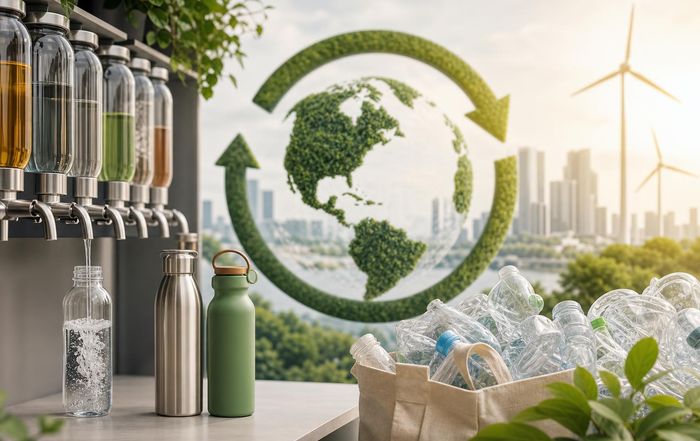
Why Refill Stations Matter for a Circular Economy
Refill stations are appearing in supermarkets, small zero-waste shops, corporate offices, and even at fuel forecourts repurposed for electric mobility and bio-based fuels. At first glance, they can look like a niche lifestyle choice: bring your own container, refill detergent, shampoo, grains, or drinks, and skip the single-use packaging. Yet behind this simple idea lies a powerful tool for reshaping how materials flow through the global economy. Refill systems directly challenge the "take-make-waste" model and help build the circular economy many governments, businesses, and communities now say they want. Understanding why refill stations matter means looking beyond the aesthetics of glass jars and metal dispensers, and examining how they change incentives, infrastructure, and daily habits.
From Linear to Circular: Where Refill Stations Fit
In a linear economy, resources are extracted, turned into products, used briefly, and then discarded as waste. This model underpins everything from fast fashion to disposable coffee cups. A circular economy, by contrast, aims to keep materials in use at their highest value for as long as possible, through strategies like reuse, repair, remanufacturing, and recycling. Organizations such as the Ellen MacArthur Foundation and UN Environment Programme describe this shift as essential for tackling climate change, biodiversity loss, and pollution, not just as a recycling upgrade but as a redesign of entire systems.
Refill stations sit squarely in the "reuse" and "reduce" layers of this hierarchy. Rather than focusing only on end-of-pipe solutions such as recycling, they cut waste and emissions earlier in the product life cycle by eliminating or drastically shrinking the need for single-use packaging. When a household reuses the same container dozens of times to refill dish soap or cooking oil, it avoids repeated production of bottles, caps, labels, and shipping materials. Studies referenced by groups like WRAP in the UK and Zero Waste Europe show that reusable packaging systems can significantly reduce greenhouse gas emissions and resource demand compared with single-use, especially when refill and return rates are high.
This upstream focus is crucial because packaging is a major driver of waste and emissions. According to OECD data, plastic packaging is one of the largest contributors to plastic waste globally. Refill stations offer a way to cut that waste at the source rather than trying to capture and recycle it after disposal. For readers interested in how this connects to broader sustainable lifestyles, the logic aligns closely with themes explored in our own coverage of sustainable living and plastic recycling, but with a stronger emphasis on prevention over treatment.
Cutting Plastic and Packaging Waste at the Source
Most people encounter refill stations through the lens of packaging reduction. Supermarkets in Europe and Asia, for example, have piloted refill aisles for dry goods, cleaning products, and personal care items, while dedicated zero-waste shops in cities from London to São Paulo organize their entire model around bulk dispensing. This matters because plastic production continues to rise globally despite increasing awareness of pollution. UNEP has highlighted that plastic production could triple by 2060 without stronger measures, and only a small share of plastic waste is currently recycled into similar-quality products.
Refill stations attack this problem by changing what counts as "necessary" packaging. Instead of each purchase coming with a new container, the container becomes a durable asset owned by the user. Over time, a single jar or bottle can displace dozens or hundreds of single-use equivalents. That not only reduces plastic but also cuts associated materials such as paper labels, metal closures, and complex laminates that are difficult to recycle. By removing the need to collect and process so many disposable items, refill systems also ease pressure on municipal waste systems and recycling infrastructure, which many cities-especially in the Global South-struggle to fund and manage.
However, not all refill systems are automatically better. Life-cycle assessments from institutions such as ETH Zurich and various national environment agencies suggest that the environmental benefit depends on factors like the material of the reusable container, how many times it is used, and how far people travel to refill. A heavy glass bottle that is only reused twice and driven long distances can have a higher footprint than a lightweight recycled plastic bottle. This nuance underscores why refill stations must be embedded in wider strategies for waste reduction and urban planning, not treated as a silver bullet. When designed well-located close to where people already shop, paired with lightweight but durable containers, and supported by efficient logistics-they can be one of the most powerful tools available to cut packaging waste.
Lowering Emissions Through Smarter Product Delivery
Refill stations also matter because they help reduce greenhouse gas emissions beyond packaging. Many household and personal care products are mostly water. Shipping water around the world in heavy bottles is energy-intensive. Concentrated refills, powders, or tablets that are reconstituted at home, combined with local refill hubs, can drastically shrink transport emissions. Companies experimenting with this model often cite data showing significant reductions in CO₂ compared with conventional bottled formats, and independent analyses by organizations like Carbon Trust have supported the general principle that concentrated, refillable systems can be more carbon-efficient.
At the store level, refill stations allow products to be delivered in bulk containers that are refilled or returned for cleaning, reducing the volume of packaging per unit sold. Bulk transport can be optimized for space and weight, which in turn lowers fuel use. For climate-conscious businesses working on sustainable business strategies, this shift can contribute to Scope 3 emissions reductions, the often-dominant category covering supply-chain and customer-use emissions. As regulators in the EU, UK, and other regions tighten climate reporting requirements, companies are under growing pressure to demonstrate credible emissions cuts across their value chains, not just in their own facilities.
Of course, the climate benefits depend on operational details. Refill stations require cleaning, dispensing equipment, sometimes refrigeration, and staff time. If these are powered by fossil-heavy electricity or poorly maintained, they can erode some of the gains. This is where integration with wider climate change policies becomes important. When refill infrastructure is powered by renewable electricity, planned around efficient logistics, and monitored for leakage and waste, it contributes to a systemic decarbonization pathway rather than a cosmetic green gesture.
Changing Consumer Habits and Normalizing Reuse
Beyond physical flows of materials, refill stations are powerful because they change social norms. Single-use culture has been normalized over decades through advertising, product design, and convenience-oriented retail. Refill systems ask people to plan ahead-remembering containers, accepting minor waiting times, and sometimes adapting to different product formats. Initially, this can feel like a barrier. But behavioral research from institutions like Behavioural Insights Team and University of Oxford suggests that when sustainable options are made visible, easy, and socially accepted, habits can shift surprisingly quickly.
Refill stations make reuse tangible and visible in everyday life. Children see adults bringing containers; colleagues notice each other topping up coffee or cleaning products; shoppers encounter prominent messaging about waste reduction. These cues reinforce the idea that materials have value beyond a single use. Over time, this can spill over into other behaviors, from repairing electronics to choosing public transport. For readers interested in lifestyle change and personal well-being, the sense of agency that comes with such practices can also be psychologically rewarding, countering the climate anxiety that often accompanies news about environmental crises.
To maximize this behavioral impact, design matters. Clear signage, intuitive dispensing systems, transparent pricing, and supportive staff all help reduce friction. Retailers experimenting with refill often find that first-time users need guidance-how to tare containers, how to avoid spills, how to compare prices per weight. When these small hurdles are addressed, satisfaction and repeat use increase. Education campaigns by groups such as Greenpeace and Plastic Pollution Coalition have further amplified awareness of plastic pollution, making consumers more receptive to refill options when they encounter them in stores or workplaces.
Business Innovation and Economic Opportunities
Refill stations are not only about individual choices; they also open new business models. For retailers, refill systems can create stronger customer loyalty, as people who invest in reusable containers and become familiar with a store's refill offering are more likely to return regularly. For brands, offering refill options-either through in-store dispensers, returnable containers, or at-home concentrate packs-can differentiate products in crowded markets and respond to regulatory and consumer pressure to reduce packaging.
There is also a growing ecosystem of technology and service providers around refill. Start-ups and established companies are developing smart dispensers with digital tracking, closed-loop container logistics, and software to monitor stock levels and hygiene. These innovations intersect with broader themes of innovation, technology, and business, as refill becomes less of a niche experiment and more of a mainstream supply-chain function. Organizations like the World Economic Forum and World Business Council for Sustainable Development have highlighted reuse and refill as key levers in corporate circular economy strategies, often alongside deposit-return schemes and product-as-a-service models.
Economically, refill stations can reduce long-term packaging costs, though they require upfront investment in equipment, training, and sometimes store redesign. Small, independent refill shops often operate with lean margins but can thrive in communities where values-driven consumption is strong. Larger retailers may achieve economies of scale, especially when collaborating with multiple brands to standardize container formats and logistics. Policy incentives-such as reduced waste fees, grants for circular infrastructure, or extended producer responsibility (EPR) schemes that reward reuse-can further tilt the economics in favor of refill. Governments in parts of Europe and Asia are beginning to explore such measures, and resources from bodies like the European Commission and OECD provide guidance for policymakers and businesses navigating these shifts.
Policy, Regulation, and Global Context
Refill stations matter more when they are supported by coherent policy frameworks. Several jurisdictions are moving from voluntary initiatives to binding rules that explicitly encourage reuse. The European Union's proposed revisions to the Packaging and Packaging Waste Regulation, for example, include reuse and refill targets for certain sectors, alongside restrictions on some single-use formats. While legislative details may evolve, the direction is clear: regulators increasingly view reuse infrastructure, including refill stations, as a necessary part of meeting waste and climate goals.
Internationally, negotiations under the UN plastic pollution treaty process signal growing consensus that upstream measures-reducing production and promoting reuse-are essential. Organizations such as UNEP and OECD emphasize that recycling alone cannot keep pace with projected plastic growth. Refill stations, as a practical embodiment of reuse, provide a visible, implementable approach that cities and businesses can adopt while broader global agreements take shape.
Public health and safety regulations also shape refill systems. Food safety authorities like the US Food and Drug Administration and counterparts in Europe and Asia set standards for hygiene, contamination prevention, and labeling. These rules are vital for consumer protection but can be challenging for small businesses to navigate. Clear guidance, standardized best practices, and supportive inspections can ensure that refill stations deliver both environmental and health benefits. When regulators, businesses, and civil society collaborate, refill can be scaled without compromising safety or transparency.
Design, Accessibility, and Equity Considerations
For refill stations to contribute meaningfully to a circular economy, they must be accessible and equitable, not just a premium option for affluent neighborhoods. Early zero-waste shops often catered to higher-income consumers, sometimes with prices above mainstream supermarkets. If refill remains a niche, it risks reinforcing environmental inequality, where wealthier groups can opt into sustainable options while low-income communities continue to bear the brunt of pollution and waste facilities.
Designing refill systems with equity in mind means locating them in diverse neighborhoods, integrating them into mainstream supermarkets and community centers, and ensuring that refill prices are competitive. Bulk purchasing can, in principle, lower costs, but savings are not automatic; they depend on procurement, logistics, and margin decisions. Municipalities and cooperatives can play a role here, setting up community refill hubs or supporting social enterprises that provide affordable essentials in refillable formats. This aligns with broader discussions about lifestyle and economic justice in sustainable transitions.
Accessibility also includes physical design. Refill equipment should be usable by people with different abilities, including those with limited strength, mobility, or vision. Adjustable heights, clear labeling, spill-resistant nozzles, and staff assistance can make a big difference. Digital tools-such as apps that show nearby refill locations or track savings in waste and carbon-can enhance engagement, but offline accessibility remains crucial, particularly in regions with limited smartphone or internet access. Design organizations and inclusive-design specialists, including universities and groups like Design Council or World Design Organization, have begun exploring how circular infrastructure can be made more user-friendly and inclusive.
Integrating Refill Stations into Broader Circular Strategies
Refill stations are one piece of a larger puzzle. A truly circular economy also involves durable product design, repair services, sharing platforms, remanufacturing, and effective end-of-life recycling for materials that cannot be reused indefinitely. For example, refillable beverage bottles still eventually wear out and need to be recycled; refill containers may break; bulk transport packaging must be managed responsibly. In this sense, refill complements rather than replaces efforts to improve plastic recycling and other waste management systems.
Businesses and cities that treat refill as a standalone marketing feature risk missing its full potential. Instead, refill infrastructure can be connected to deposit-return schemes, digital tracking of packaging flows, and public reporting on waste and emissions reductions. Educational programs in schools and communities-an area we explore further in our coverage of education and environmental awareness-can use refill stations as tangible teaching tools about resource cycles. Universities and technical institutes can study real-world refill pilots to refine design, logistics, and policy frameworks.
Internationally, different regions will adopt refill in distinct ways, shaped by local culture, retail structures, and infrastructure. In some European cities, supermarket-based refill aisles may dominate; in parts of Asia and Africa, informal refill practices at markets and neighborhood shops-already common for cooking oil, water, or cleaning products-may be formalized and improved for safety and traceability. Recognizing and supporting these diverse models, rather than imposing a single template, will be key to scaling refill as a meaningful contributor to circularity.
What Success Looks Like?
If refill stations fulfill their potential within a circular economy, several changes become visible. Single-use packaging volumes decline, and municipal waste systems report lower tonnages of packaging waste. Households own fewer disposable containers and more durable ones, and shopping routines incorporate regular refilling without feeling burdensome. Businesses shift a measurable share of their sales to refill or reusable formats, backed by transparent data on waste and emissions reductions. Policymakers embed refill targets and support mechanisms into broader climate, waste, and economic strategies, and public awareness of reuse normalizes it across generations.
None of this will happen automatically. Refill systems must prove themselves convenient, safe, affordable, and reliable. They need sustained investment, supportive regulation, and thoughtful design. Yet their importance for a circular economy lies precisely in this blend of practicality and symbolism. Refill stations turn abstract goals-like closing material loops and decoupling growth from resource use-into everyday actions at the supermarket, workplace, or neighborhood shop. They invite people, businesses, and governments to participate in a different story about how goods are provided and consumed.
For those working to "save our world" through more sustainable living, business innovation, and systemic change, refill stations are not the whole answer. But they are a concrete, scalable, and visible step toward an economy where resources flow in circles rather than lines-and where waste is no longer the inevitable outcome of daily life.
