
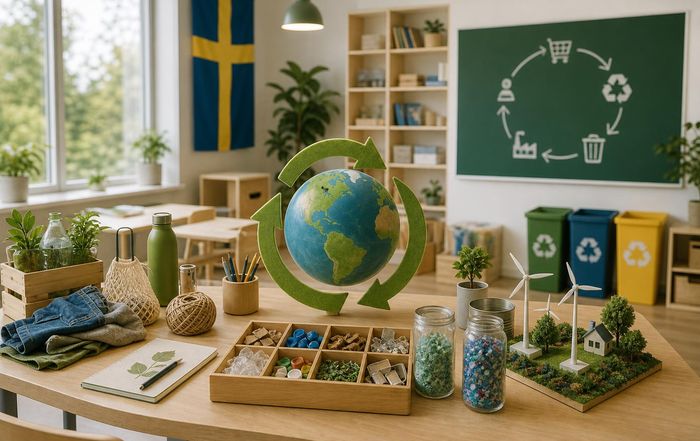
How Schools in Sweden Can Teach Circular Consumption
Sweden is often held up as a sustainability leader, yet it still consumes resources at a rate that would require several planets if replicated worldwide. For a country that prides itself on environmental leadership, that contradiction is increasingly uncomfortable. One of the most powerful levers for change lies in the school system: the habits, values, and skills that young people develop in classrooms and workshops will shape how Sweden moves from a "take-make-waste" economy toward a circular one. Teaching circular consumption is not simply about recycling more; it is about helping students understand materials, value longevity over novelty, and design systems where waste is minimized or eliminated. Swedish schools are already experimenting with this shift, but there is still enormous untapped potential.
Why circular consumption belongs in every Swedish classroom
Circular consumption is rooted in the idea that products, materials, and resources should stay in use for as long as possible, be repaired and reused, and ultimately be recycled or composted in ways that regenerate natural systems rather than deplete them. Organizations such as the Ellen MacArthur Foundation and the OECD describe the circular economy as a systemic transformation of how societies design, produce, and use goods. For students, that abstract concept becomes real when they see how their clothes, smartphones, food, and furniture move through supply chains, and what happens when those items are discarded.
In Sweden, this shift aligns with national climate goals and with the broader European Green Deal. The European Commission has made circularity a central pillar of its climate and industrial strategy, while the Swedish government, through agencies such as Naturvårdsverket (the Swedish Environmental Protection Agency), has emphasized sustainable consumption and waste reduction as critical to meeting climate targets. Integrating circular consumption into schooling complements existing education for sustainable development (ESD) requirements and Sweden's long tradition of environmental awareness. It also responds to the reality that many young people are anxious about climate change and ecological breakdown; circular thinking can give them a sense of agency by connecting everyday choices to systemic solutions.
For an international audience, Sweden's approach is instructive because it shows how a wealthy, high-consumption society can use education to challenge its own patterns. Circular consumption education is not an add-on topic; it connects to broader themes such as sustainable living, waste, climate change, and innovation. When schools embed these ideas in core subjects and daily routines, they help normalize a culture where resources are treated as precious rather than disposable.
Linking circular consumption to Sweden's curriculum and policy
Sweden's national curriculum already includes sustainability and environmental issues, particularly through the lens of democracy, ethics, and critical thinking. The challenge is not starting from zero but making circular consumption a visible, coherent thread rather than a scattered collection of projects. Agencies like Skolverket (the Swedish National Agency for Education) provide guidance on ESD, while international frameworks from UNESCO and the UN Environment Programme (UNEP) emphasize circularity as part of sustainable lifestyles and responsible consumption.
Circular consumption can be woven into existing curriculum objectives rather than requiring an entirely new subject. In science, students can examine material life cycles, energy use, and pollution from extraction to disposal, connecting these to planetary boundaries research from institutions such as the Stockholm Resilience Centre. In social studies and economics, they can explore how consumer culture, marketing, and global trade patterns encourage overconsumption, and how alternative models-sharing economies, repair services, product-as-a-service-are emerging. In technology and design, they can learn to prioritize durability, modularity, and repairability, connecting directly to themes of sustainable business and design.
At policy level, Sweden's national waste plan and circular economy strategies already emphasize prevention, reuse, and recycling. Schools can be framed explicitly as implementation hubs for these policies. Municipalities responsible for schooling and waste management can partner to align school procurement rules, cafeteria operations, and waste systems with national circular goals. This creates a living laboratory where students can see how public policy translates into concrete practices, from sorting food waste to purchasing refurbished IT equipment.
Turning the school itself into a circular classroom
The most powerful lessons about circular consumption often come not from textbooks but from how a school operates. When the school becomes a model of circular practice, students experience sustainability as normal rather than theoretical. One starting point is a thorough audit of material flows: what comes into the school (food, paper, electronics, furniture, cleaning products, art supplies) and what leaves as waste or surplus. Students can help conduct this audit, working with teachers and custodial staff to map waste streams and identify hotspots. This kind of hands-on investigation links directly to environmental awareness and gives students data to analyze in maths, science, and social science classes.
Cafeterias are a particularly visible arena for teaching circular consumption. Many Swedish municipalities already sort food waste for biogas or composting, but schools can go further by tracking food waste quantities, experimenting with portion sizes, promoting plant-rich menus, and discussing the climate and biodiversity impacts of different diets. Guidance from organizations such as the Food and Agriculture Organization of the United Nations (FAO) and WWF can support lesson plans on food systems, while students can compare their school's performance to national or international benchmarks. Linking these activities to sustainable living and personal well-being helps students see how food choices affect both health and the planet.
Procurement and resource use also offer rich teaching moments. Schools can prioritize reused or refurbished furniture, laptops, and lab equipment, drawing on guidance from the Swedish Energy Agency and EU-level initiatives on green public procurement. When a school chooses remanufactured computers or rents devices instead of buying new, teachers can use that decision as a case study in circular business models. Students can examine contracts, calculate cost savings, and compare environmental impacts. This ties directly into business and economy topics, showing that circular choices can be financially rational as well as environmentally responsible.
Classroom projects that make circularity tangible
Abstract appeals to "consume less" often fail to resonate with young people whose identities are partly shaped by fashion, technology, and social media. Effective circular consumption education therefore emphasizes creativity, problem-solving, and agency rather than guilt. Project-based learning works particularly well, allowing students to design and test circular solutions in their own lives.
One common starting point is clothing, a major contributor to global emissions and waste. Students can map the journey of a T-shirt from cotton field to store, using resources from organizations such as the International Labour Organization (ILO) and Greenpeace to explore labor conditions, water use, and chemical pollution. They can then organize clothing swap events, repair workshops, or upcycling projects, learning basic sewing and mending skills along the way. This not only reduces waste but also challenges fast-fashion norms and connects to broader themes of plastic recycling and material stewardship.
Electronics offer another rich arena. Many Swedish households have drawers full of unused phones, cables, and gadgets. Schools can run "e-waste weeks" where students bring in old devices, learn about the metals and rare earth elements inside them, and work with local recyclers to understand what can and cannot be recovered. Organizations such as the International Telecommunication Union (ITU) and Bureau of International Recycling (BIR) provide background on global e-waste challenges. Students can design campaigns to extend device lifespans through better care, software updates, and repair, or even explore simple hardware fixes under supervision. These projects illustrate how circular thinking intersects with technology and global justice, since much e-waste is exported to lower-income countries.
Younger pupils can engage with circularity through storytelling and play. For example, they might follow the "life story" of a plastic bottle, from oil extraction to a supermarket shelf to a recycling plant, and then imagine alternative futures-refill systems, reusable containers, or avoiding the bottle altogether by using tap water. Teachers can draw on materials from UNICEF and UNESCO that are tailored to children's understanding, emphasizing care for nature and fairness between generations. Simple classroom practices-such as shared pencil banks, rotating toy libraries, or art projects using scrap materials-help embed the idea that resources are shared and cycles matter.
Collaborating with municipalities, NGOs, and circular businesses
Swedish schools do not need to teach circular consumption in isolation. Many municipalities, companies, and civil-society organizations are already experimenting with circular models and can serve as partners, mentors, and living case studies. Municipal waste companies, for example, often run reuse centers, repair cafés, and recycling stations that welcome school visits. These visits can be prepared and followed up in class, helping students connect what they see-piles of discarded furniture, electronics, and textiles-to discussions about overconsumption and system design.
Partnerships with local circular businesses can be particularly inspiring. Companies that rent out clothes, refurbish electronics, or run sharing platforms for tools and sports equipment provide concrete examples of how entrepreneurship can support circular consumption. Organizations such as Företagarna (representing Swedish businesses) and international networks like the World Business Council for Sustainable Development (WBCSD) highlight case studies that teachers can adapt. Students can interview entrepreneurs, analyze their business models, and even develop their own circular business ideas in group projects that tie directly into sustainable business and innovation.
Non-governmental organizations also play a critical role. Environmental groups like Greenpeace, Friends of the Earth, and WWF produce educational materials on consumption, waste, and climate that can be adapted for Swedish contexts. Youth-led movements and local climate groups can be invited to speak about campaigns that address fast fashion, plastic pollution, or food waste, showing how civic engagement and circular consumption intersect. These collaborations need to be handled carefully to maintain schools' political neutrality, but they can help students see themselves as active citizens rather than passive consumers.
Using data, digital tools, and systems thinking
Teaching circular consumption is not only about moral arguments; it also involves building analytical skills. Data and digital tools can help students understand the scale of resource use and evaluate the impact of different choices. International organizations such as the World Bank, UNEP, and the International Energy Agency (IEA) provide statistics on material extraction, energy use, and emissions. Students can use these datasets to compare Sweden's resource footprint with other countries, or to examine how consumption patterns have changed over time.
Life-cycle assessment (LCA) is one powerful tool that can be simplified for classroom use. Even without advanced software, students can compare the cradle-to-grave impacts of, for example, a disposable coffee cup versus a reusable mug, or a beef burger versus a plant-based alternative. They can consider raw materials, manufacturing, transport, use, and end-of-life stages, learning to think in systems rather than in isolated products. This kind of analysis ties into education for critical thinking and scientific literacy, helping students question simplistic "green" marketing claims.
Digital platforms can also support circular behavior directly. Schools can experiment with internal sharing systems for sports equipment, musical instruments, and lab materials, using simple apps or spreadsheets to manage circulation. Students in technology or IT classes can design prototypes for such platforms, exploring user experience, privacy, and accessibility considerations. By building the tools that enable sharing and reuse, they gain a deeper understanding of how technology can either reinforce or challenge linear consumption norms.
Addressing social justice, identity, and well-being
Circular consumption is sometimes framed narrowly as a technical or environmental issue, but for education to be meaningful it must also address social and psychological dimensions. Consumption is tied to identity, belonging, and status, especially for teenagers who are negotiating peer relationships and social media pressures. If circular education simply tells students to "buy less" without acknowledging these realities, it risks alienating them.
Swedish schools can draw on research and guidance from organizations like the World Health Organization (WHO) and UNICEF to explore how materialism, social comparison, and online advertising affect mental health and personal well-being. Classroom discussions can examine how influencers shape trends, how planned obsolescence and fast fashion rely on constant novelty, and how alternative values-creativity, repair skills, uniqueness-can be sources of pride. Activities like customizing second-hand clothes or building furniture from reclaimed materials can help students see circular practices as expressions of individuality rather than sacrifice.
Justice is another critical dimension. Many of the environmental and health impacts of Sweden's consumption fall on people in other countries, where raw materials are mined, goods are manufactured, and waste is often dumped or burned. Organizations such as Amnesty International and Human Rights Watch have documented labor abuses and pollution in supply chains for electronics, textiles, and other goods. Bringing these perspectives into the classroom helps students understand circular consumption as part of global solidarity, not just domestic waste management. It also creates space to discuss affordability and access: circular options like organic food or rental services may be out of reach for some families, so schools need to avoid moralizing and focus on structural change and collective solutions.
Supporting teachers and overcoming practical barriers
For circular consumption to be taught effectively, teachers need time, resources, and confidence. Many educators are already stretched, and asking them to add "one more topic" can feel unrealistic. Professional development and peer-learning networks are therefore essential. Swedish teacher unions and subject associations, together with agencies like Skolverket and international bodies such as UNESCO, can offer training modules on circular economy concepts, project-based learning methods, and assessment strategies that value systems thinking and collaboration.
Schools can also reduce the burden on individual teachers by creating cross-curricular teams that plan circular projects together. For example, a unit on electronics could involve technology teachers (repair and design), science teachers (materials and energy), social studies teachers (global supply chains and labor rights), and language teachers (communication campaigns). This not only distributes the workload but also models the interdisciplinary nature of real-world sustainability challenges. Aligning circular projects with existing grading criteria helps ensure that they are not seen as "extras" but as central to core learning goals.
Funding is another barrier. Repair workshops, maker spaces, and field trips require resources. Municipalities and regional authorities can support schools through targeted grants, often aligned with broader climate or innovation strategies. Partnerships with local businesses and NGOs can provide tools, materials, and expertise, though schools must manage these relationships carefully to avoid undue commercial influence. International programs such as Erasmus+, coordinated by the European Commission, may offer opportunities for cross-border exchanges where Swedish schools can share and learn from circular education initiatives in other countries.
Measuring impact and building a culture of circularity
Finally, Swedish schools need ways to understand whether their efforts are making a difference. Measuring impact should go beyond counting how many recycling bins have been installed. Instead, schools can track indicators such as reductions in food waste, increases in reused or refurbished equipment, or the proportion of students who report feeling capable of influencing environmental outcomes. Simple annual surveys and waste audits can provide baseline data and show progress over time.
Qualitative evidence also matters. Student projects, reflections, and portfolios can reveal how their understanding of consumption and responsibility is evolving. Are they asking different questions about new purchases? Are they challenging marketing messages? Are they initiating circular projects at home or in their communities? Documenting and sharing these stories-through school websites, local media, or networks focused on global sustainability-can inspire other schools and demonstrate that circular education is not an abstract ideal but a lived practice.
Over time, the goal is to move from isolated initiatives to a culture where circular thinking is woven into the identity of the school. This means that new teachers are inducted into existing practices, student councils have a voice in sustainability decisions, and parents are engaged as partners rather than bystanders. It also means recognizing that circular consumption is not a fixed endpoint but an evolving journey. Technologies, policies, and social norms will continue to change, and Swedish schools can serve as places where the next generation learns not just specific practices-repairing a bike, organizing a swap event-but the deeper skills of questioning, designing, and caring that a truly circular society requires.
