
The Benefits of Repairing Appliances Instead of Replacing Them
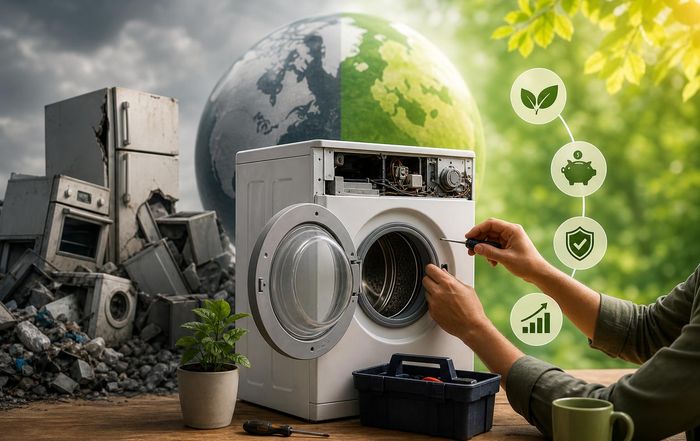
When a washing machine stops spinning or a fridge starts humming loudly, the modern reflex is often to shop for a replacement. Yet repairing appliances instead of discarding them can save money, cut climate pollution, reduce waste, and support more resilient local economies. Around the world, policymakers, consumer advocates, and grassroots "right to repair" movements are pushing back against throwaway culture and making repair practical again. Now we will explore why repair so often beats replacement, when a fix makes sense, and how households can build a more sustainable relationship with the products they rely on every day.
Why repair matters for the planet
Most of an appliance's environmental impact is locked in long before it reaches a kitchen or laundry room. Manufacturing a new refrigerator, dishwasher, or laptop requires mining raw materials, processing metals and plastics, and shipping components and finished goods around the world. Each step consumes energy and generates greenhouse gas emissions.
Studies summarized by organizations such as the UN Environment Programme and OECD indicate that the production phase of many durable goods can account for a large share of their lifetime carbon footprint. Extending the life of existing products through repair spreads that "embedded" impact over more years of use, which is one of the simplest forms of sustainable living.
Repairing instead of replacing also helps tackle the fast-growing problem of electronic and electrical waste. According to the International Telecommunication Union and United Nations University, global e-waste has been rising steadily and only a fraction is formally collected and recycled. Appliances often contain hazardous substances and complex material mixes that are difficult to recycle safely and economically. Keeping them in use longer reduces pressure on already strained waste systems and aligns directly with the goals of a more circular, low-waste economy, a topic explored further in our waste coverage.
Beyond carbon and waste, repair can reduce the demand for resource-intensive materials such as copper, rare earth elements, and high-grade plastics. Organizations like the Ellen MacArthur Foundation and European Environment Agency highlight that extending product lifetimes is one of the most effective strategies for reducing material throughput in the economy. In practice, that means every successful repair is a small but real contribution to easing pressure on ecosystems and climate systems worldwide.
Financial advantages: repair as a household climate strategy
From a household perspective, the most immediate benefit of repair is often financial. Large appliances are expensive, and prices have generally trended upward as devices become more complex and feature-rich. Repair costs can look high in isolation, but they are usually much lower than full replacement, especially when the appliance is mid-life rather than near the end of its expected service.
Consumer organizations such as Consumer Reports in the United States and Which? in the United Kingdom regularly analyze whether it is more economical to repair or replace common appliances. Their guidance often converges on a simple rule of thumb: if a repair costs less than roughly half the price of a new unit and the appliance has significant life expectancy remaining, repair is usually the better option. While this is not a strict formula, it offers a starting point for evaluating quotes and avoiding unnecessary purchases.
Repair can also prevent indirect costs. Replacing a built-in dishwasher or oven may involve cabinetry work, plumbing or electrical modifications, delivery charges, and disposal fees for the old unit. These extras add up, especially in cities where bulky waste handling is expensive. In contrast, many common failures-worn belts in washing machines, faulty refrigerator thermostats, or clogged dishwasher pumps-can be fixed with relatively inexpensive parts and a single service visit.
For households trying to align budgets with climate goals, repair can be treated as a form of "climate-smart frugality." Choosing repair over replacement not only saves money but also reduces the emissions associated with manufacturing and shipping a new product. For readers interested in connecting personal finances with environmental impact, our sections on sustainable business and economy explore these links at a broader scale.
Understanding the climate trade-off: repair vs. efficiency
There is one legitimate complication: newer appliances are often more energy-efficient. Replacing a very old, inefficient refrigerator or clothes dryer with a high-efficiency model can significantly reduce electricity use and emissions over time. Agencies such as the U.S. Department of Energy, the European Commission, and labeling schemes like ENERGY STAR and the EU energy label emphasize that upgrading to efficient equipment can be a key part of climate mitigation.
The climate question, then, becomes a comparison between:
The emissions and resource use embedded in manufacturing and shipping a new appliance, plus its lower operating energy over its lifetime, and
The emissions saved by avoiding new production and keeping an existing appliance running, even if it uses somewhat more energy.
Researchers at institutions such as Fraunhofer Institute and various universities have analyzed this trade-off. While results vary by product type and local electricity mix, several patterns emerge:
For many mid-life appliances (for example, a 7-year-old washing machine or 8-year-old dishwasher), repairing and continuing to use them is usually better environmentally than replacing them immediately with a slightly more efficient model.
For very old and highly inefficient units-especially refrigerators, freezers, and electric resistance water heaters-replacement with a significantly more efficient or lower-carbon alternative can be justified from both cost and climate perspectives.
The greener choice is particularly sensitive to how carbon-intensive the local electricity grid is. In regions with coal-heavy power, efficiency gains can matter more; in areas with cleaner grids, the production footprint of a new appliance looms larger.
Consumers can use available tools, such as energy label calculators from government agencies or utility companies, to estimate potential energy savings. Weighing those savings against the climate cost of manufacturing a new unit is not always straightforward, but the principle is clear: repair first, upgrade when efficiency gains are truly substantial or when the old appliance is near the end of its useful life.
For readers interested in the broader climate context, our climate change section offers more background on how household decisions aggregate into significant global impacts.
Cutting waste and supporting a circular economy
Repair sits at the heart of the circular economy concept, which aims to keep products and materials in use for as long as possible rather than following the traditional "take-make-dispose" linear model. A circular approach prioritizes designing products that can be repaired, refurbished, and eventually recycled at high value.
Organizations such as the Ellen MacArthur Foundation, Circle Economy, and the World Economic Forum highlight repair as a key strategy for reducing waste and resource use across global supply chains. When appliances are repaired:
Fewer units enter municipal waste streams, easing pressure on landfills and incinerators.
Demand for virgin materials declines, which can reduce habitat destruction, water pollution, and energy use linked to mining and refining.
The value embedded in existing products-labor, energy, and materials-is preserved rather than discarded.
This shift is starting to show up in policy. The European Union has adopted and expanded "ecodesign" and right to repair rules that require certain appliances to be designed for easier disassembly and to have spare parts available for a minimum number of years. Similar discussions and initiatives are underway in the United States, Canada, Australia, and several Asian and African countries, often driven by coalitions of environmental organizations, consumer groups, and independent repair businesses. Groups such as iFixit, the Repair Café Foundation, and the Restart Project have become prominent voices in these debates.
For people who care about environmental awareness, repair is not just a technical act; it is a statement about how products should be made, used, and valued. Each repaired appliance is a small but meaningful example of circular economy principles in action.
The social and economic value of repair skills
Repairing appliances is not only an environmental or financial issue; it also has social and economic dimensions. Local repair businesses-independent appliance technicians, electronics repair shops, and community workshops-create jobs that are often more rooted in local economies than large-scale manufacturing and distribution chains. Supporting these services keeps money circulating within communities and builds practical skills that can be shared and passed on.
International organizations like the International Labour Organization (ILO) and OECD emphasize that green transitions must include quality local jobs. Repair is one of the most tangible forms of "green work": it directly prevents waste and reduces material demand while providing livelihoods. In regions facing deindustrialization or limited formal employment opportunities, repair enterprises can offer accessible entry points for small-scale entrepreneurs.
Community repair events, such as Repair Cafés and Fixit Clinics, add another layer of value. They bring people together to learn how to troubleshoot appliances, mend clothing, or fix electronics, often at no or low cost. Participants gain confidence, technical literacy, and a sense of agency over their possessions. This aligns closely with the themes of education and personal well-being, as people experience the satisfaction of solving problems and reducing waste.
At a cultural level, repair challenges the idea that products are disposable and that technical systems are too complex for non-experts to understand. By demystifying appliances and sharing knowledge, communities can reduce dependence on constant consumption and foster a more resilient, skills-rich society.
When repair makes sense-and when replacement is justified
Not every appliance should be repaired at any cost. A balanced approach considers safety, cost, efficiency, and practicality. Several factors help determine whether repair or replacement is the better choice:
Age and expected lifespan:If an appliance is relatively new and has a typical design life of 10-15 years-such as many washing machines and refrigerators-repairing a fault that emerges in the first half of its life usually makes sense. For very old units that have already exceeded expected lifespans, replacement may be more reasonable, especially if failures are frequent.
Type of fault and repair cost:Simple issues like worn door seals, clogged filters, faulty switches, or broken latches are generally inexpensive to fix. Major failures such as compressor breakdowns in refrigerators or cracked drums in washing machines can be costlier. Comparing multiple repair quotes and the price of a similar new model helps clarify the economics.
Energy efficiency gap:If an appliance is significantly less efficient than current models-typical for refrigerators or freezers over 15-20 years old-the long-term energy savings from replacement can outweigh the environmental cost of new production. Government energy agencies and utilities often provide calculators to estimate potential savings, and labels like ENERGY STAR and EU energy classes offer indicative comparisons.
Safety considerations:If an appliance has a serious safety defect, such as recurring electrical shorts, damaged insulation, or a history of overheating, replacement may be the safest option, especially if reputable technicians advise against repair. Checking product recall information from agencies such as the U.S. Consumer Product Safety Commission, European Commission Safety Gate, or national regulators can help identify known hazards.
Availability of parts and expertise:Some older or highly proprietary models may suffer from limited spare parts availability, driving up costs or making repair impossible. However, policy changes in several regions are increasingly requiring manufacturers to supply parts and documentation for a minimum period. In many cases, independent technicians or specialized online suppliers can still source components even when manufacturers no longer stock them.
In practice, a "repair-first" mindset does not mean repairing at any cost. It means starting with the question, "Can this be safely and affordably repaired?" rather than defaulting to replacement. Even when replacement is ultimately chosen, exploring repair options ensures the decision is informed rather than automatic.
Designing for repair: policy, business, and innovation
One of the biggest barriers to repair has been product design itself. Many modern appliances and electronics are built with glued components, proprietary fasteners, sealed batteries, and software locks that make diagnosis and repair difficult. In response, policymakers, engineers, and advocates are pushing for design changes that prioritize durability and maintainability.
The European Union's ecodesign and right to repair regulations have begun to require that certain categories of appliances-such as washing machines, dishwashers, refrigerators, and displays-be designed so that key components can be replaced with common tools, and that spare parts remain available for several years after a product is discontinued. Similar legislation and voluntary commitments are emerging in the United States, Canada, and parts of Asia, often supported by coalitions of environmental NGOs, consumer groups, and independent repairers.
From a business perspective, companies are experimenting with new models that incentivize longer product lifetimes. Examples include extended manufacturer-backed repair services, subscription or leasing schemes where companies retain responsibility for maintenance, and modular designs that allow individual parts to be upgraded without replacing entire units. Organizations like Ellen MacArthur Foundation, World Business Council for Sustainable Development, and various national innovation agencies have highlighted these models as promising components of a circular economy.
Technological innovation is also reshaping repair. Digital diagnostics, open-source repair manuals, and online communities enable both professional technicians and skilled amateurs to tackle increasingly complex problems. Platforms that share step-by-step guides and teardown information have become important resources, complementing traditional service manuals. Our innovation and technology sections regularly explore how such tools can support more sustainable lifestyles.
Ultimately, shifting from a throwaway model to a repair-friendly one requires alignment between policy, corporate design choices, and consumer expectations. As awareness grows, pressure on manufacturers to support repair is likely to increase, opening opportunities for more robust and serviceable appliances.
Practical steps to make repair your default
For households and individuals who want to prioritize repair, a few practical habits can make a significant difference.
First, prevention is a powerful form of repair. Simple maintenance-cleaning filters on dryers and dishwashers, defrosting freezers, descaling kettles and washing machines in hard-water areas, checking door seals, and avoiding overloading-can extend the life of appliances and prevent many common breakdowns. Many manufacturers, energy agencies, and consumer organizations provide basic maintenance checklists on their websites.
Second, building a relationship with a trusted local repair service can transform how problems are handled. Instead of immediately browsing for new products when something fails, having a known technician to call encourages repair-first thinking. Asking for an initial diagnosis and cost estimate helps determine whether a fix is sensible without committing to a full repair.
Third, for those comfortable with tools and safety precautions, some repairs can be tackled at home. Replacing refrigerator light bulbs, cleaning clogged drain pumps, or swapping worn door gaskets are within reach for many people, especially with guidance from reputable sources. However, work involving gas connections, high-voltage components, or sealed refrigeration systems should generally be left to professionals to avoid safety risks.
Fourth, when shopping for new appliances, considering repairability upfront can pay long-term dividends. Questions to ask include: Are spare parts readily available? Does the manufacturer provide service manuals to independent technicians? Are common failure points accessible and modular? Independent reviews, right-to-repair scorecards, and consumer forums can offer insights. Choosing brands with a track record of durability and support may cost more initially but often proves more economical and sustainable over time.
Finally, households can integrate repair into a broader lifestyle of mindful consumption. This might include joining or supporting community repair events, sharing tools and knowledge with neighbors, or advocating for policies that protect the right to repair. When combined with other sustainable practices-such as plastic recycling, energy conservation, and low-waste habits-repair becomes part of a coherent approach to living well within planetary boundaries.
Repair as a quiet form of climate action
Repairing appliances rarely attracts headlines, but its cumulative impact is significant. Every time an appliance is fixed instead of replaced, resources are conserved, emissions are avoided, skills are valued, and local economies are supported. In a world grappling with climate change, biodiversity loss, and mounting waste, these seemingly small decisions add up.
For many households, making repair the default choice is one of the most accessible forms of environmental action. It does not require major lifestyle sacrifices or expensive technology; it simply asks that products be given a second, third, or fourth chance before being discarded. As policies evolve, manufacturers adapt, and repair cultures grow, choosing repair over replacement can help align everyday life with a more sustainable, resilient future.
