
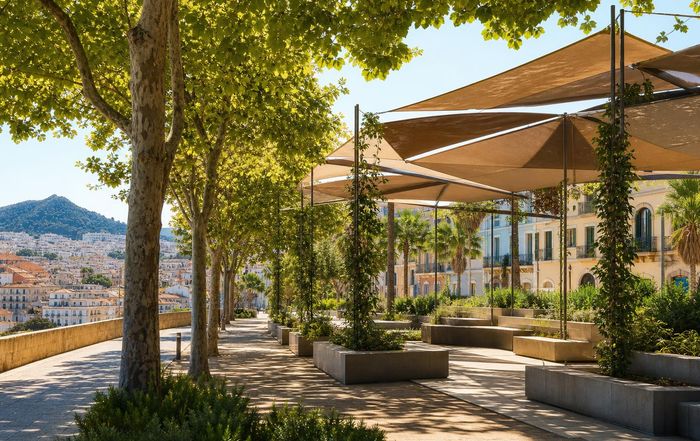
Urban Shade Planning for Heatwaves in Southern Europe
Southern Europe is warming faster than the global average, and its cities are at the sharp edge of this change. Repeated summer heatwaves, prolonged droughts, and record-breaking night-time temperatures are turning familiar streets into hazardous environments, especially for older people, children, and those with existing health conditions. Urban shade planning-deliberately designing streets, buildings, trees, and public spaces to keep people cool-is emerging as one of the most practical and equitable tools to protect city dwellers while cutting energy use and emissions.
This 'hot and flooded' article looks at how shade planning works in practice, why it matters so much in Mediterranean climates, and what city authorities, businesses, and residents across Southern Europe can do to rapidly scale up cooler, more resilient urban environments.
Why heatwaves hit Southern European cities so hard
The Mediterranean region is identified by the Intergovernmental Panel on Climate Change as a climate "hotspot," warming faster than many other regions and facing more frequent and intense heat extremes. According to the World Meteorological Organization and World Health Organization, heatwaves are already the deadliest weather-related hazard in Europe, with tens of thousands of excess deaths recorded during major events such as the 2003, 2019, and 2022 summers. Urban areas in Southern Europe-from Lisbon and Barcelona to Rome, Athens, and Istanbul-are particularly vulnerable due to a combination of climatic and built-environment factors.
Dense building patterns, dark roofing and paving materials, limited vegetation, and heavy car traffic create powerful urban heat islands, where city temperatures can be several degrees higher than in surrounding rural areas. At night, concrete and asphalt slowly release stored heat, preventing the body from recovering, raising indoor temperatures, and increasing the risk of heat-related illness. Socioeconomic factors amplify this: many residents live in older, poorly insulated buildings without air conditioning, or cannot afford to run cooling systems continuously as energy prices fluctuate.
For cities that already face water stress and seasonal drought, simply relying on more air conditioning is neither sustainable nor equitable. It increases electricity demand, worsens peak loads on grids, and, if powered by fossil fuels, further drives climate change. Urban shade planning, by contrast, focuses on passive cooling: reducing exposure to direct solar radiation, improving microclimates, and cutting surface temperatures so that streets, homes, and public spaces remain usable and safer during heatwaves.
For readers interested in how these interventions support sustainable living, they connect directly with broader efforts to cut emissions, improve public health, and reduce wasteful energy use in buildings and transport. Related discussions on energy-efficient lifestyles and climate impacts are explored in more depth in our sections on sustainable living and climate change.
What "urban shade planning" actually means
Urban shade planning goes beyond planting a few extra trees. It is a coordinated strategy that looks at where people walk, wait, work, and rest-and then uses design, vegetation, and materials to ensure those places are shaded and cooler during the hottest hours. It sits at the intersection of urban design, public health, and climate adaptation, and is increasingly embedded in city climate plans across Europe.
Planners typically begin with heat mapping and vulnerability analysis, using satellite data, ground sensors, and citizen input to identify hotspots: exposed plazas, bus stops, schoolyards, and older neighborhoods with little greenery. Tools developed by agencies such as the European Environment Agency and research institutions like Copernicus Climate Change Service provide high-resolution temperature and land-use data that help target interventions where they will have the greatest impact on health and comfort.
Shade solutions then combine permanent and flexible elements. Permanent measures include street trees, pergolas, arcades, canopies, and building overhangs. Flexible or seasonal measures include awnings, tensile fabric structures, and temporary shade sails installed for summer. Material choices-cool roofs and pavements with higher solar reflectance, lighter façades, and permeable surfaces-complement shade by reducing the amount of heat absorbed in the first place. These interventions can be integrated into new developments or retrofitted into existing streetscapes, often as part of broader urban regeneration, transport, or waste and water infrastructure projects.
For cities aiming to integrate shade planning into broader environmental strategies, it naturally connects with themes we explore under environmental awareness and innovation, including the use of digital tools and nature-based solutions.
Lessons from Southern European cities already acting
Several Southern European cities have become early laboratories for heat- and shade-focused planning, showing both what is possible and what remains challenging when retrofitting dense, historic urban fabrics.
In Athens, one of Europe's most heat-exposed capitals, the city has appointed a Chief Heat Officer and developed a heat action plan with support from networks like C40 Cities and the Adrienne Arsht-Rockefeller Foundation Resilience Center. Measures include mapping "cool routes" through shaded streets and parks, installing reflective surfaces on public buildings, and upgrading public spaces with trees and shading structures. Pilot projects in schoolyards and squares demonstrate how modest investments can significantly improve thermal comfort.
Barcelona has integrated heat resilience into its "superblock" model and public space strategy. Shaded tree-lined streets, restricted car access, and expanded pedestrian areas are accompanied by a network of "climate shelters" in schools, libraries, and community centers. These shelters often feature green courtyards, pergolas, and shaded play areas, making them usable even on very hot days. The city's work is frequently cited by organizations like ICLEI - Local Governments for Sustainability and the European Commission as an example of combining mobility, health, and climate adaptation.
Lisbon, Seville, and Valencia have all experimented with cool pavements, expanded tree planting along major avenues, and shaded bus stops, often drawing on guidance from bodies such as the World Bank and UN-Habitat on climate-resilient urban design. Seville has also gained attention for naming and categorizing heatwaves, a communication approach intended to raise public awareness similar to how storms are named.
These examples show that urban shade planning is not an abstract concept: it is already being translated into specific design standards, zoning rules, and investment programs. Yet even in these pioneering cities, coverage is incomplete, and vulnerable neighborhoods often lag behind more central or touristic areas, underlining the need to frame shade as a matter of equity and public health, not just aesthetics or tourism.
Readers interested in how these efforts intersect with green entrepreneurship and municipal budgets can find broader context in our coverage of sustainable business and economy.
Trees, pergolas, and cool materials: the core tools of shade
The most familiar shade intervention is the street tree, and for good reason. Research summarized by organizations such as the Food and Agriculture Organization of the United Nations and the European Forest Institute suggests that well-designed urban tree canopies can reduce surface temperatures by 10-25°C on hot days and lower mean radiant temperature (what the body "feels") by several degrees. In Mediterranean climates, species selection is crucial: trees must tolerate drought, heat, and sometimes poor soils, while providing dense crowns and relatively low allergenic potential. Native or well-adapted species are generally preferred to reduce water demand and support local biodiversity.
However, trees alone are not always enough or feasible. Narrow historic streets, underground utilities, and competition for space with cycling lanes, tram tracks, and café terraces can limit planting opportunities. Here, architectural shade becomes important: arcades, balconies, overhangs, and pergolas can provide reliable shade in places where trees cannot grow or would interfere with heritage façades. Many Southern European cities already have traditional arcaded streets and courtyards; integrating these typologies into modern developments can extend their cooling benefits.
Material choices add another layer. Cool roofs and pavements, promoted by organizations such as the Lawrence Berkeley National Laboratory and the Global Cool Cities Alliance, use lighter colors and high-reflectance coatings to bounce more solar radiation back into the atmosphere. In Southern Europe, reflective surfaces are already part of traditional architecture-whitewashed buildings in Greek islands or Andalusian towns are an early form of passive cooling. Expanding these principles through updated building codes and street design can significantly reduce local heat build-up. Permeable and lighter-colored pavements, combined with shade, can further lower temperatures and improve stormwater management.
These physical interventions align closely with the broader sustainable design themes discussed in our design and technology sections, where materials science, digital modeling, and traditional knowledge increasingly intersect.
Integrating water, vegetation, and microclimate design
Shade planning is most effective when combined with blue-green infrastructure-water and vegetation systems that work together to cool the city. In hot, dry summers, evaporative cooling from water features and transpiration from plants can reduce local temperatures and improve comfort, but must be balanced with water scarcity and drought risk.
Some Mediterranean cities are restoring or reinterpreting historic water systems-fountains, rills, and shaded courtyards with small pools-using recirculated or non-potable water to limit consumption. Organizations like UNESCO and IWA (International Water Association) have highlighted traditional Islamic and Mediterranean garden designs as early examples of climate-adapted cooling landscapes. Modern versions use efficient pumps, smart controls, and drought-tolerant planting to achieve similar effects with less water.
Green roofs and façades, while more common in Northern Europe, are gaining traction in Southern climates when designed with appropriate species and irrigation strategies. They provide additional insulation, shade building envelopes, and contribute to urban biodiversity. Combined with reflective materials and shading devices, they create multi-layered cooling that benefits both indoor and outdoor environments.
At street level, integrating planting beds, bioswales, and pocket parks into transport and redevelopment projects can create cool corridors that connect larger parks and waterfronts. When these corridors are shaded and walkable, they encourage active mobility, reducing car dependency and associated emissions. This synergy between climate adaptation, public health, and sustainable mobility is increasingly central to urban climate strategies promoted by groups like Transport & Environment and Eurocities.
Our coverage of lifestyle and personal well-being often highlights how such environments support everyday health, mental restoration, and social cohesion-not just cooler temperatures.
Planning for people: equity, health, and everyday routines
Effective shade planning starts from people's daily routines: where they walk to school or work, where they change buses, where older residents sit and talk, where outdoor workers spend long hours. Public health agencies, including the World Health Organization and national health ministries, increasingly stress that urban heat is not only a meteorological issue but a social and health equity challenge.
Older adults, people with chronic illnesses, low-income households, outdoor workers, and those living in poorly insulated homes are often the most exposed. They may have less access to air conditioning, fewer options to relocate during heatwaves, and live in neighborhoods with minimal greenery. If shade investments focus mainly on central business districts or tourist areas, existing inequalities can deepen.
To counter this, some cities are combining heat vulnerability maps with demographic and health data to prioritize interventions in the most at-risk areas. This might mean shading social housing courtyards, upgrading schoolyards in low-income districts with trees and pergolas, or ensuring that bus stops in outer suburbs have roofs, seating, and drinking water. Public health agencies and NGOs such as the Red Cross Red Crescent Climate Centre have highlighted the importance of shaded, accessible "cool spaces" within walking distance for vulnerable residents.
Involving communities in identifying priority routes and spaces can make projects more effective and accepted. Participatory mapping, neighborhood workshops, and pilot installations allow residents to test what works-whether it is a row of trees, a pergola, or a combination of awnings and street-level planters. Such co-design processes can be integrated into broader education and awareness programs about climate risks, something we explore further in our education coverage.
Policy tools, regulations, and funding levers
Scaling urban shade planning across Southern Europe requires more than isolated pilot projects; it needs regulatory frameworks, incentives, and funding that embed shade into mainstream urban development. At the European level, initiatives under the European Green Deal, such as the EU Mission on Adaptation to Climate Change and the Nature Restoration Law (subject to ongoing political debate), encourage member states and cities to integrate nature-based solutions and climate resilience into planning and infrastructure investment.
National and municipal governments can use several levers:
Building codes and planning regulations can require or strongly incentivize shading elements-such as overhangs, balconies, external blinds, or minimum tree cover-for new developments and major renovations. Requirements for reflective or high-albedo roofing and façades can be introduced in heat-prone zones, following guidance from research institutes and organizations like ASHRAE and RMI.
Zoning and street design standards can embed minimum tree planting, shaded sidewalks, and covered public transport stops in all major road upgrades. Parking minimums can be reduced while tree and planting minimums are increased, freeing space and budget for shade.
Financial incentives-grants, low-interest loans, tax reductions, or density bonuses-can support private investments in shade structures, green roofs, and façade greening, especially for social housing and small businesses. EU funds, national climate adaptation budgets, and green bonds can help finance larger public projects such as shaded plazas, schoolyard retrofits, and park expansions.
Public procurement rules can prioritize materials and designs with high cooling performance and low environmental impact, supporting innovation in cool materials and modular shade structures. This aligns with broader themes around sustainable business and innovation that we cover under business and innovation.
International networks like C40 Cities, ICLEI, and the Global Covenant of Mayors for Climate & Energy provide technical guidance, case studies, and peer learning opportunities, helping Southern European cities adapt global best practices to local conditions.
Balancing shade with heritage, tourism, and local identity
Southern Europe's cities are often defined by their historic architecture, plazas, and vistas. Introducing new shade structures or trees into UNESCO-listed areas or tightly protected historic centers can raise concerns about visual impact, heritage conservation, and tourism. Yet many of the region's traditional urban forms-narrow streets, internal courtyards, arcades, shutters-were originally developed as climate responses, long before mechanical cooling.
Urban shade planning in historic contexts often means reviving and adapting traditional solutions rather than imposing entirely new typologies. For example, retractable awnings and fabric canopies, already common in many Mediterranean markets and streets, can be designed to meet modern safety and aesthetic standards while preserving key sightlines. Lightweight pergolas with climbing plants can frame rather than obscure historic façades. Carefully chosen tree species and planting layouts can enhance, rather than compete with, monumental spaces.
Tourism economies also depend on comfortable public spaces. Prolonged heatwaves can reduce outdoor activity, shorten tourist seasons, and increase health risks for visitors unfamiliar with local climates. By integrating shade into promenades, archaeological sites, waterfronts, and cultural venues, cities can protect both residents and visitors while reinforcing their reputation as welcoming destinations. Organizations such as UNWTO (World Tourism Organization) and ICOMOS have begun to discuss climate adaptation in heritage and tourism management, providing principles that can guide such interventions.
This balance between conservation, climate resilience, and local identity reflects a broader theme we often explore in our global coverage: sustainability is not about erasing cultural distinctiveness, but about enabling places to thrive under new climatic realities.
Practical steps cities and communities can take now
While comprehensive shade strategies require long-term planning and investment, many steps can be taken quickly at city, neighborhood, and building scale. Municipal authorities can start by systematically mapping heat and shade, integrating this data into transport, housing, and public space projects so that every new investment contributes to cooler streets. Prioritizing schools, healthcare facilities, social housing, and major pedestrian corridors ensures that limited budgets deliver maximum social and health benefits.
At the same time, building owners and businesses can retrofit shading devices-external blinds, awnings, pergolas, and balcony shading-often at relatively low cost compared with mechanical cooling upgrades. Simple measures such as painting roofs and façades lighter colors, installing reflective coatings where appropriate, and adding potted plants or small trellises in courtyards can cumulatively make a difference, especially when replicated across entire blocks.
Community groups and NGOs can advocate for shaded bus stops, benches, and small pocket parks in underserved neighborhoods, using heat-mapping tools and local knowledge to build the case. Schools and parent associations can push for shaded play areas and green schoolyards, which not only reduce heat exposure but also support children's well-being and learning.
Climate aware individuals who want to connect these practical steps to their own behavior and choices can explore other positive inspirational content under sustainable living, waste, and lifestyle, where everyday decisions-from home improvements to mobility choices-interact with city-scale planning.
Towards cooler, fairer Mediterranean cities
Heatwaves are no longer rare anomalies in Southern Europe; they are a recurring feature of summer and are projected by scientific bodies like the IPCC and European Environment Agency to intensify further in coming decades. Urban shade planning offers a practical, relatively low-tech, and co-beneficial response that can be scaled across cities of very different sizes and incomes. It protects health, reduces energy demand, enhances public space, and can restore elements of traditional Mediterranean urbanism that were always adapted to hot, dry summers.
The challenge now is speed and equity. Shade must reach the most exposed neighborhoods, not just flagship boulevards. It must be embedded into building codes, transport projects, and regeneration schemes rather than added as an afterthought. And it must be planned with communities, health experts, and climate scientists at the table, ensuring that every tree, awning, and pergola is part of a coherent network of cooler routes and safe spaces.
For Southern European cities-and for other regions facing similar climates-investing in shade is not only a design choice; it is an essential part of living sustainably and safely in a warming world.
