
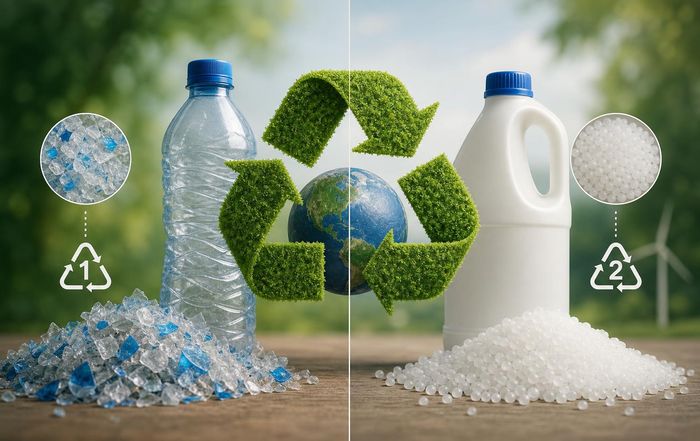
Recycling PET and HDPE: What Really Makes Them Different?
Plastic bottles and containers often look similar, but the way they are made, used, and recycled can be very different. Two of the most common packaging plastics worldwide are PET and HDPE. Understanding how they differ-chemically, in recycling systems, and in environmental impact-can help consumers, businesses, and policymakers make better choices and support more effective recycling.
This eco minded article unpacks what PET and HDPE are, why they dominate packaging, how their recycling processes differ, and what that means for sustainable living and circular design.
PET vs HDPE: What Are They?
Polyethylene terephthalate (PET) and high-density polyethylene (HDPE) are both thermoplastics, meaning they can be melted and reformed. They are part of the broader family of plastics marked with resin identification codes-those small numbers inside a triangle on packaging.
PET is typically labeled with the number 1, while HDPE carries the number 2.
PET is a polyester. It is lightweight, strong, and transparent, which makes it ideal for beverage bottles, food packaging, and many consumer products. According to organizations such as PlasticsEurope and the American Chemistry Council, PET is one of the most widely used plastics globally for single-use drink containers. Its clarity and ability to form a tight barrier against carbon dioxide and oxygen are essential for carbonated drinks and many foods, helping preserve flavor and shelf life.
HDPE, by contrast, is a type of polyethylene with a higher density and more linear molecular structure. This gives it greater stiffness, chemical resistance, and impact strength. HDPE is usually opaque or translucent rather than clear. It is widely used for milk jugs, detergent bottles, shampoo containers, household chemical packaging, and rigid pipes. Because of its robustness and resistance to many chemicals, HDPE is common in both consumer goods and industrial applications.
Both plastics are technically recyclable, but their different properties mean they follow different pathways in recycling systems and become different kinds of new products.
Where PET and HDPE Show Up in Everyday Life
In most households, PET and HDPE appear side by side, but in distinct roles that reflect their physical characteristics and regulatory requirements.
PET dominates the market for single-use beverage bottles-water, soft drinks, juices, sports drinks, and some edible oils. It is also used for many food trays, blister packs, and some jars where transparency and perceived cleanliness are important. In some regions, PET is increasingly used for thermoformed packaging, such as salad containers and clamshells for berries or baked goods. Textiles are another major outlet: much of the world's polyester clothing and many carpets and industrial fibers are made from PET, often in the form of recycled PET (rPET).
HDPE is more common in products where strength and chemical resistance matter more than clarity. Milk and juice jugs, laundry detergent bottles, household cleaners, shampoos and conditioners, motor oil containers, toys, buckets, and rigid pipes are often made from HDPE. In agriculture and construction, HDPE is used for piping, geomembranes, and protective sheeting. Many reusable crates and pallets are also HDPE, capitalizing on its durability.
For people trying to live more sustainably, recognizing these common uses helps in sorting waste correctly and in choosing products with more recyclable packaging. Articles on sustainable living often highlight the importance of understanding these material differences when making everyday purchasing decisions.
Chemical and Physical Differences That Shape Recycling
The distinct behavior of PET and HDPE in recycling plants begins with their chemistry and physical properties.
PET has an aromatic polyester backbone, giving it rigidity and good gas barrier performance. It melts at a relatively high temperature compared with many other packaging plastics and can crystallize, which influences how it is processed into new products. PET's density is typically greater than that of water, so PET flakes tend to sink in water-based separation systems.
HDPE, on the other hand, is a semi-crystalline polyolefin consisting of long chains of ethylene units. It has lower density than PET and is usually less dense than water, so HDPE pieces generally float during sink-float separation. It melts at a lower temperature than PET, is more flexible in some formulations, and is highly resistant to many chemicals.
These differences drive how recycling facilities separate and process them. In material recovery facilities (MRFs), optical sorters and near-infrared (NIR) technology are often used to distinguish PET from HDPE on fast-moving conveyor belts. Because PET and HDPE have different melting points and mechanical properties, mixing them together in the same recycling stream typically degrades the quality of the resulting material. This is why "bottle-to-bottle" recycling depends so heavily on clean, well-sorted streams.
Organizations such as the Association of Plastic Recyclers in North America and Plastics Recyclers Europe have developed detailed design-for-recycling guidelines based on these material differences, encouraging companies to select compatible labels, caps, and colorants for each polymer.
How PET Is Recycled: From Bottles to New Products
PET recycling has become one of the more established plastic recycling systems globally, particularly for beverage bottles. Many countries report relatively high PET bottle collection rates compared with other plastics, though performance varies widely.
The typical mechanical recycling process for PET involves several stages:
Collected PET bottles are first sorted from mixed recyclables using automated systems and sometimes manual quality checks. Clear PET is usually preferred because it offers maximum flexibility for creating new clear or colored products, while colored PET often has more limited end markets.
The sorted PET is then shredded into flakes. Labels and caps, which are often made from polyolefins such as polypropylene (PP) or HDPE, are removed, often with hot washing and friction-based equipment. Because PET sinks and many label and cap materials float, water-based separation is particularly effective here.
The clean PET flakes may undergo further washing and drying to remove adhesives, residues, and contaminants. In food-contact applications, additional decontamination steps-such as super-clean processes under vacuum-are used to meet safety standards set by regulators like the European Food Safety Authority and the U.S. Food and Drug Administration.
The flakes are then melted and extruded into pellets, which can be used to make new bottles, packaging, fibers, strapping, and other products. In bottle-to-bottle recycling, these pellets are blended with virgin PET or, in some advanced operations, used at very high recycled content levels.
Chemical recycling technologies for PET-such as depolymerization into monomers-are being developed and scaled by various companies and research institutions. Organizations like Ellen MacArthur Foundation and UNEP have highlighted these approaches as part of broader circular economy strategies, while also noting their energy demands and the need for robust life-cycle assessments.
For consumers, one of the visible outcomes of PET recycling is the proliferation of bottles and packaging labeled with "made from recycled PET" or "contains X% rPET." These labels signal demand for recycled material, which can help stabilize markets and support investment in collection and processing infrastructure.
How HDPE Is Recycled: Strength, Color, and Contamination Challenges
HDPE recycling has its own well-developed but distinct process. Because HDPE is used in a wider variety of products-including containers for detergents, oils, and chemicals-contamination issues can be more complex than with PET beverage bottles.
In a typical HDPE recycling process, containers are first sorted from mixed plastics. Optical sorters can distinguish HDPE from PET and other polymers, and in some facilities, separate natural (unpigmented) HDPE from colored HDPE. Natural HDPE, often used for milk jugs, is especially valuable because it can be turned into light-colored or even food-contact applications more easily than heavily pigmented material.
The sorted HDPE is shredded into flakes or ground into regrind. Because HDPE generally floats in water, sink-float separation can help remove heavier contaminants and separate HDPE from denser plastics like PET. Washing steps remove residues from detergents, oils, and other contents, but containers that held hazardous or industrial chemicals may be excluded from certain recycling streams for safety reasons.
Clean HDPE flakes are then melted and pelletized. Recycled HDPE (rHDPE) is widely used in non-food applications such as drainage pipes, plastic lumber, bins, crates, and non-food bottles. In some jurisdictions, regulators allow rHDPE in certain food-contact applications under strict conditions, but the regulatory framework is often more restrictive than for PET, reflecting the more varied and potentially problematic prior uses of HDPE containers.
Color is a major issue. Dark or mixed-color HDPE tends to be downcycled into products where appearance is less important, such as black drainage pipes or composite lumber. This reality has prompted design-for-recycling guidance from groups like WRAP in the UK and various industry coalitions, which encourage brands to avoid dark pigments that hinder sorting and to use labels and closures that do not contaminate the HDPE stream.
Collection Systems: Why PET and HDPE Perform Differently
Collection systems have a significant influence on how much PET and HDPE actually get recycled, regardless of their technical recyclability. Deposit return schemes (DRS) for beverage containers, which are in place in many European countries, parts of North America, and elsewhere, typically focus on PET bottles and sometimes metal cans. These systems, when well designed, can achieve very high return rates, sometimes above 80-90%, according to data from organizations like Reloop and various national environment agencies.
HDPE containers, especially for household chemicals and personal care products, are more often collected through curbside or bring-bank recycling programs without deposits. Participation, contamination, and sorting efficiency can vary widely. As a result, global recycling rates for HDPE packaging often lag behind PET bottles, although there are exceptions where strong extended producer responsibility (EPR) systems or high landfill costs encourage better performance.
In some regions, mixed waste sorting systems are emerging that aim to recover both PET and HDPE after general household waste has been collected, using advanced optical sorting and robotics. However, these systems are still relatively new and vary in effectiveness. For readers interested in broader waste and resource issues, the performance of PET and HDPE in different collection models is a critical part of understanding why plastic recycling statistics differ so much between countries.
End Markets: What Recycled PET and HDPE Become
The strength of end markets is one of the key differences between PET and HDPE recycling.
Recycled PET has well-established, high-volume outlets. In addition to bottle-to-bottle applications, rPET is widely used in fibers for clothing, carpets, automotive interiors, strapping, thermoformed packaging, and more. The textile industry in particular has become a major consumer of rPET, with many brands promoting garments made from "recycled plastic bottles." However, organizations like Textile Exchange and independent researchers have raised concerns that when bottles are converted into textiles that are not themselves recycled, this can divert material away from closed-loop bottle systems and may not represent the most circular use of the material.
Recycled HDPE markets are also significant but often more fragmented. rHDPE is commonly used in outdoor furniture, decking, pipes, bins, pallets, and non-food bottles. Some countries mandate minimum recycled content in certain plastic products, which can boost demand for rHDPE. However, color and quality variations can limit its use in high-value applications, and price competition with virgin HDPE, which is derived from fossil fuels, remains a challenge.
From a sustainable business perspective, companies that commit to using minimum levels of recycled content in packaging help create stable demand for both rPET and rHDPE. This, in turn, encourages investment in collection, sorting, and processing infrastructure-an important link between corporate commitments and practical sustainable business outcomes.
Environmental Footprints and Life-Cycle Considerations
When comparing PET and HDPE, many people want to know which is "better for the environment." The answer is nuanced and depends on the specific application, local waste management systems, and how many times the material is recycled.
Life-cycle assessments (LCAs) conducted by organizations such as UNEP, academic institutions including MIT, and various national environment agencies generally find that both PET and HDPE have lower greenhouse gas emissions and resource use than heavier materials like glass or metal in some applications, particularly when transportation impacts are considered. However, these comparisons can shift when reuse, recycling rates, litter, and ocean pollution are taken into account.
PET's advantages include light weight, high recyclability (especially in closed bottle-to-bottle loops), and well-developed collection systems in some regions. Its disadvantages include reliance on fossil feedstocks, potential microplastic shedding from polyester textiles, and the risk that low collection rates lead to leakage into the environment.
HDPE is similarly light and durable, and its resistance to chemicals makes it suitable for long-lived products like pipes and outdoor furniture when recycled. However, pigment use and varied prior contents can complicate high-quality recycling, and in many places HDPE packaging is not collected or sorted as effectively as PET bottles.
Independent analyses by groups like the OECD and Ellen MacArthur Foundation emphasize that improving design, collection, and reuse systems often has a greater impact than choosing one polymer over another in isolation. Shifting to refill and reuse models, avoiding unnecessary packaging, and designing for recyclability across the entire product system can reduce environmental burdens more than incremental material substitutions.
For readers exploring broader climate change and global environmental impacts, it is important to see PET and HDPE not as inherently "good" or "bad," but as materials whose sustainability depends heavily on how societies manage them.
Design for Recycling: Practical Differences for Brands and Designers
From a design perspective, PET and HDPE have different "rules of the game" if the goal is to maximize recyclability and maintain material quality.
For PET, design-for-recycling guidelines from groups like the Association of Plastic Recyclers and RecyClass typically recommend clear or light-blue bottles, avoiding full-sleeve labels that hinder sorting, using labels and adhesives that wash off easily, and specifying closures made from compatible polyolefins that can be separated in the washing process. Barriers, additives, and colorants that interfere with optical sorting or discolor the recycled material are discouraged.
For HDPE, guidance emphasizes using natural (unpigmented) or light-colored resins where possible, selecting labels and sleeves that do not contaminate the HDPE stream, avoiding metal components, and designing closures that stay attached (to reduce litter) while still being compatible with the recycling process. Because HDPE is used for a wider variety of products, designers must also consider what their packaging will likely have contained and whether that will limit future uses of the recycled material, especially in sensitive applications.
Designers working on sustainable design face trade-offs between branding, shelf appeal, barrier performance, and recyclability. Increasingly, retailers and regulators in regions such as the EU and parts of North America are introducing eco-modulation of fees-charging lower producer responsibility fees for packaging that is easier to recycle and higher fees for problematic formats. This trend directly links design choices to financial incentives, making PET/HDPE recyclability differences a business issue as much as a technical one.
Consumer Choices: How to Handle PET and HDPE at Home
For individuals trying to reduce waste and support recycling, the PET-HDPE distinction matters in several practical ways.
First, correct sorting is essential. PET bottles (code 1) and HDPE containers (code 2) are widely accepted in municipal recycling programs in many countries, but local rules differ. Residents should check their local authority or waste management company's guidance. Organizations like EPA in the United States and various municipal portals in Europe provide detailed instructions on what is accepted in curbside bins.
Second, preparation matters. Emptying containers, giving them a quick rinse if heavily soiled, and replacing caps where local programs ask for that can improve recycling outcomes. While labels usually do not need to be removed at home, avoiding mixing non-recyclable items, such as plastic films or heavily contaminated packaging, in the same bin helps reduce sorting costs and contamination.
Third, purchasing decisions can reinforce better systems. Choosing products in clear PET or natural HDPE, favoring brands that disclose recycled content, and avoiding unnecessary multi-material packaging all contribute to more effective recycling markets. Readers interested in lifestyle changes that support sustainability may also consider shifting to refill systems, reusable containers, and bulk purchasing where practical, which can reduce reliance on both PET and HDPE single-use packaging.
Finally, advocacy plays a role. Supporting deposit return schemes, extended producer responsibility policies, and investments in modern sorting and recycling facilities can help ensure that both PET and HDPE are more consistently collected and recycled, rather than landfilled or incinerated.
Innovation and the Future of PET and HDPE Recycling
Innovation in PET and HDPE recycling is advancing on several fronts, driven by climate goals, corporate commitments, and public concern about plastic pollution.
In PET recycling, chemical depolymerization technologies aim to break PET down to its monomers, which can then be purified and repolymerized into material with properties comparable to virgin PET. Companies and research centers in Europe, North America, and Asia are piloting and scaling such technologies, with support from brands seeking to meet recycled content targets. However, as groups like Greenpeace and some academic researchers have noted, questions remain about energy use, emissions, and economic viability at scale.
For HDPE, improvements in optical sorting, digital watermarking for packaging identification, and advanced washing systems are helping to raise the quality of recycled material and expand its applications. Research into compatibilizers-additives that help mixed polyolefin streams behave more like single polymers-is also underway, potentially enabling more flexible use of mixed HDPE/PP waste in durable products.
Policy developments, such as the ongoing negotiations toward a global plastics treaty under the auspices of the United Nations Environment Programme, could accelerate investment and standardization in plastic recycling systems worldwide. At the same time, many experts stress that recycling alone cannot solve plastic pollution and that upstream measures-such as reduction, reuse, and redesign-are essential.
For those following innovation and technology in the environmental space, PET and HDPE recycling offer a clear example of how materials science, policy, and consumer behavior intersect. The trajectory of these two plastics will help shape whether future packaging systems are more circular or continue to rely heavily on linear, fossil-based models.
Bringing It Together: Choosing and Managing PET and HDPE Wisely
PET and HDPE are both central to modern packaging and both technically recyclable, yet their differences-chemistry, typical uses, recycling pathways, and end markets-have important implications for sustainability.
PET excels in transparent, lightweight beverage and food packaging, with relatively mature bottle-to-bottle recycling systems in many regions. HDPE provides robust, chemically resistant packaging and durable products, but faces more challenges with color, contamination, and consistent collection. Neither material is inherently sustainable; their environmental impact depends on design choices, policy frameworks, recycling infrastructure, and everyday behavior.
For households, that means recognizing and correctly sorting codes 1 and 2, supporting policies and brands that prioritize recyclability and recycled content, and reducing unnecessary single-use packaging wherever possible. For businesses and designers, it means aligning packaging choices with design-for-recycling guidelines, investing in circular models, and considering the full life cycle of materials-from resource extraction to end-of-life.
Clever readers interested in deepening their understanding of environmental awareness, technology, and business trends around plastics will find that the story of PET and HDPE recycling is not just about two polymers. It is a lens on how societies can move from a throwaway culture toward systems that respect materials, reduce waste, and help save our world.
