
Understanding Plastic Recycling Labels in the United States
Plastic packaging in the United States is covered in arrows, numbers, and claims like "100% recyclable" or "ocean-bound plastic." Much of it looks green and reassuring, yet only a fraction of plastic actually gets recycled. Understanding what those labels really mean is one of the most practical steps consumers, businesses, and policymakers can take to reduce waste and support truly sustainable living. This important and necessary reminder explains how U.S. plastic recycling labels work, what has recently changed in law and policy, and how to make better choices-whether you are sorting your household recycling, designing packaging, or setting sustainability goals for a business.
Why plastic recycling labels are so confusing
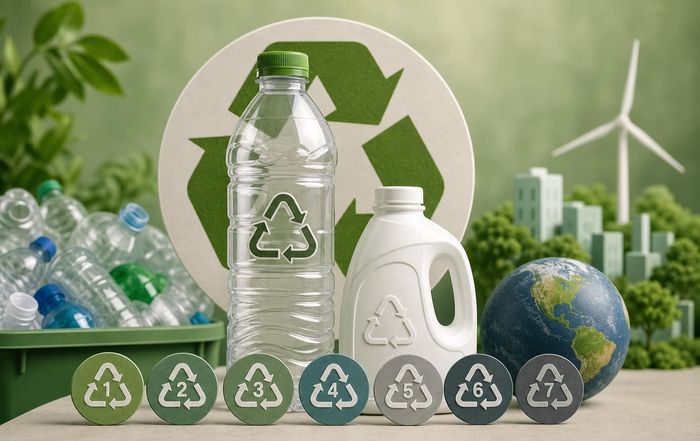
For decades, the most familiar symbol on plastic has been the "chasing arrows" triangle with a number inside. Many people assume this means "recyclable." In reality, that symbol was originally designed as a resin identification code-essentially a way to say "this is plastic type #1, #2, etc."-not a guarantee that local facilities will accept or successfully recycle it.
In the United States, recycling is mostly run at the city or county level. Local programs differ widely in what plastics they accept and can economically process. A bottle marked with a recycling symbol might be accepted in one city, landfilled in another, and exported as mixed scrap somewhere else. At the same time, companies have used green imagery and broad claims like "eco-friendly" or "recyclable where facilities exist," which are often too vague for consumers to interpret. The result has been widespread "wishcycling": placing items in the recycling bin in the hope that they will be recycled, even when they are not compatible with the local system.
Environmental organizations such as Greenpeace USA and the Environmental Protection Agency (EPA) have highlighted the gap between labeling and reality, noting that only a small share of plastic packaging-primarily PET (#1) bottles and HDPE (#2) bottles and jugs-is recycled at scale in the U.S. While exact rates fluctuate, federal data show that overall plastic recycling remains low compared with materials like paper, metal, and glass. This context is critical when evaluating any recycling symbol on plastic packaging.
Environmentally aware people looking for broader context on waste and materials systems may find our dedicated pages on waste and climate change helpful, as plastic production and disposal are closely tied to fossil fuels and greenhouse gas emissions.
The resin identification codes: what the numbers 1-7 actually mean
The numbered triangle on plastic-often mistaken for a universal recycling symbol-is formally known as the Resin Identification Code (RIC). It was developed by the plastics industry in the late 1980s and later standardized by organizations such as ASTM International. The codes indicate the type of plastic resin, not whether an item will be recycled in practice.
Here is what the main numbers mean and how they relate to real-world recycling in the U.S.:
#1 - PET or PETE (Polyethylene Terephthalate)Common in clear beverage bottles, some food containers, and clamshells. PET bottles and jugs are among the most widely collected and recycled plastics in the United States. However, PET clamshells (such as salad or berry boxes) are less consistently accepted and can contaminate bottle-focused streams. When local guidelines mention "bottles and jugs," they usually mean rigid containers with a neck, not all PET items.
#2 - HDPE (High-Density Polyethylene)Used for milk jugs, detergent bottles, shampoo bottles, and some rigid containers. Like PET bottles, HDPE bottles and jugs are widely accepted in curbside programs and have relatively strong end markets. Colored HDPE (e.g., detergent bottles) is often downcycled into products like pipes or plastic lumber, whereas natural HDPE (e.g., milk jugs) can be turned into food-grade material more easily.
#3 - PVC (Polyvinyl Chloride)Found in some pipes, clear packaging, and specialty products. PVC is rarely accepted in household recycling and can release problematic chemicals when processed improperly. Most PVC packaging should be kept out of curbside recycling unless a local program explicitly lists it.
#4 - LDPE (Low-Density Polyethylene)Used in plastic bags, shrink wrap, squeezable bottles, and some flexible packaging. Curbside programs typically do not accept plastic film because it tangles in sorting equipment. Some grocery stores and retailers host separate film drop-off programs, often coordinated through initiatives promoted by groups like The Recycling Partnership or How2Recycle, but participation and performance vary widely.
#5 - PP (Polypropylene)Common in yogurt cups, some caps, straws, and food containers. Polypropylene access has expanded in recent years, with many U.S. communities now accepting PP tubs, cups, and containers. However, acceptance is far from universal, and not all collected PP is recycled into high-value products. Some companies and organizations, including the Association of Plastic Recyclers (APR), are working to improve PP recycling infrastructure.
#6 - PS (Polystyrene, including foam "Styrofoam")Used in disposable cups, clamshells, trays, and protective packaging. Polystyrene is rarely recycled through curbside programs, and foam products in particular are often contaminated with food and difficult to process. Some specialized drop-off programs exist, but from a practical standpoint, most PS packaging in the U.S. is landfilled or incinerated.
#7 - Other (Mixed or Specialty Plastics)A catch-all category for plastics that do not fit into #1-#6, including polycarbonate, bioplastics, and multilayer packaging. These are typically not accepted in curbside recycling and often require specialized systems, if they are recyclable at all. Bioplastics labeled as #7, for example, may be compostable only under industrial conditions, not in home compost or standard recycling streams.
Understanding these codes is a first step in more informed plastic recycling, but they must be interpreted alongside local rules. For readers interested in broader household choices, our sustainable living and lifestyle sections explore how to reduce plastic use in daily life, not just recycle it.
The role of the chasing arrows symbol and why it is under scrutiny
The iconic "chasing arrows" symbol-three arrows forming a triangle-has become almost synonymous with recycling. Yet its use on plastic has been controversial. The symbol appears both around resin codes and on other products to suggest recyclability, but there is no single nationwide standard governing every use.
In practice, there are two distinct issues:
First, when the arrows surround a number, they function as part of the resin identification code. For many years, this was the standard way to display the code. However, critics, including environmental groups and some state attorneys general, argue that arrows inherently imply recyclability, even when a resin is rarely recycled. Some standards bodies, such as ASTM International, have updated guidance to allow the codes to be displayed in a solid triangle or other shapes to reduce confusion, though many manufacturers still use the arrowed version.
Second, the arrows appear on packaging, marketing, and labels to suggest that an item is recyclable, made from recycled content, or part of a circular system. The U.S. Federal Trade Commission (FTC), through its Green Guides, considers the chasing arrows symbol to be a form of recyclability claim. Under these guidelines, companies should only use unqualified recyclability claims when recycling facilities are available to a "substantial majority" of consumers or communities where the product is sold. If access is more limited, companies are supposed to qualify the claim (for example, by indicating that recycling is available only in certain areas).
In recent years, several U.S. states, including California, have moved to restrict the use of the chasing arrows on plastic packaging that is not actually recyclable in practice. California's Senate Bill 343, for example, directs state regulators to establish criteria for when the symbol and related claims can be used, tying them to actual collection and processing rates. Other states and advocacy groups are watching closely, and similar measures may spread, especially as the FTC works on updating the federal Green Guides and as litigation over misleading environmental claims increases.
For readers tracking the policy side of sustainability, our pages on environmental awareness and business provide additional context on how regulation and corporate responsibility are evolving.
How2Recycle and other voluntary label systems
Alongside basic resin codes, many packages in U.S. stores now carry more detailed instructions such as "Check locally," "Store drop-off," or "Widely recycled." One of the most visible systems is the How2Recycle label, a voluntary, standardized scheme used by hundreds of brands and retailers.
How2Recycle is managed by the Sustainable Packaging Coalition, a project of GreenBlue, and aims to translate complex recycling information into clear, icon-based guidance. A typical label may:
Identify the material (e.g., PET bottle, PP cap, LDPE film).
State whether the component is "Widely Recycled," "Check Locally," "Not Yet Recycled," or suitable for "Store Drop-off."
Break down multi-component packaging (such as a box, tray, and film) into separate instructions.
The system relies on national data about access to recycling for different material types, including information from organizations like The Recycling Partnership and the Closed Loop Partners network. While How2Recycle does not guarantee that every local program will accept each item, it provides more nuance than a simple symbol and helps brands communicate more transparently.
However, voluntary labels have limitations. They depend on accurate data, brand participation, and consumer attention. A label that says "Check locally" still requires the consumer to look up local rules. Moreover, even when an item is technically recyclable, contamination (such as leftover food) or design choices (like dark pigments or complex laminates) can prevent it from being recycled in practice. The Association of Plastic Recyclers publishes design-for-recycling guidelines that help companies avoid such pitfalls, but adoption is uneven across the packaging industry.
Legal standards for recyclability claims and "greenwashing" risks
As public concern about plastic waste has grown, so has scrutiny of environmental marketing and labeling. In the U.S., the main federal guidance comes from the FTC's Green Guides, which outline how companies should substantiate environmental claims, including "recyclable," "recycled content," and "compostable." Although the Green Guides are not themselves regulations, they are used to evaluate whether marketing is deceptive under federal law.
The Green Guides generally state that:
A product should not be marketed as "recyclable" unless a substantial majority of consumers or communities where it is sold have access to recycling facilities for that product.
If access is more limited, the claim should be clearly qualified (for example, "recyclable only in the few communities that have appropriate facilities").
Claims about recycled content must be truthful and based on actual material composition, including distinctions between pre-consumer and post-consumer recycled material.
At the same time, some states are enacting their own rules. California's SB 343, for example, is more prescriptive about what counts as "recyclable" for labeling purposes, relying on state-calculated recycling and sorting rates. Other states are exploring extended producer responsibility (EPR) laws for packaging, which can include labeling requirements and financial incentives for more recyclable design.
Consumer protection lawsuits have also targeted companies for allegedly misleading recyclability claims, especially when products labeled as recyclable are not accepted by most local programs or are made from materials that are rarely recycled in practice. Advocacy groups like Ocean Conservancy and Earthjustice argue that clearer, enforceable standards are needed to prevent greenwashing and to support genuinely circular packaging systems.
For businesses developing packaging or marketing sustainability claims, our sustainable business and economy pages explore the broader economic and regulatory landscape shaping corporate environmental responsibility.
How to interpret plastic recycling labels as a U.S. consumer
Given this complex backdrop, how can someone in the United States make sense of plastic recycling labels in everyday life? While local conditions vary, several practical principles can help:
First, treat the resin code as a material indicator, not a promise. Numbers #1 and #2 on bottles and jugs are the most likely to be genuinely recycled in many U.S. communities, especially when they are clean, empty, and free of attached films or pumps. Codes #3-#7, particularly on flexible or complex packaging, are often problematic, even if a recycling symbol appears.
Second, always cross-check with local guidelines. City, county, or hauler websites-often linked from municipal government pages or solid waste authorities-typically list accepted materials. Some provide visual guides or apps that allow residents to search by item. Because recycling markets and contracts change, guidelines may be updated periodically, so it is worth reviewing them from time to time.
Third, pay attention to component-level instructions. A single product can combine recyclable and non-recyclable parts: a PET bottle with a metal cap, a tray with a film lid, or a rigid tub with a multi-material label. Systems like How2Recycle or local guides may direct you to separate components, remove pumps, or keep caps on. Following these instructions can significantly improve recycling quality and reduce contamination.
Fourth, be wary of vague environmental language. Claims like "eco-friendly," "green," or "environmentally conscious" are not standardized and may not reflect actual recyclability or environmental performance. When in doubt, look for specific, verifiable information, such as the percentage of post-consumer recycled content or third-party certifications from credible organizations like UL, BPI for compostability, or respected NGOs.
Finally, remember that recycling is only one part of sustainable living. Reducing and reusing plastics-by choosing refillable containers, bulk purchasing, or alternative materials where appropriate-often has a greater environmental impact than recycling alone. Our pages on sustainable living, innovation, and technology highlight emerging solutions that go beyond traditional recycling systems.
Design, technology, and the future of plastic labeling
The way plastics are labeled is closely tied to how they are designed, collected, and processed. As recycling technology and policy evolve, labels are likely to change as well.
On the design side, many packaging producers are turning to design for recyclability principles, often guided by criteria from groups such as the Association of Plastic Recyclers, Ellen MacArthur Foundation, and major brand coalitions. These principles may include:
Using mono-material packaging instead of multi-layer composites that are hard to separate.
Avoiding problematic additives, pigments, and labels that interfere with sorting.
Standardizing formats that match what material recovery facilities (MRFs) are equipped to handle, such as bottles and rigid containers over small, flexible pieces.
Technologically, investments in optical sorters, robotics, and chemical recycling are being explored across North America. Companies and research institutions are testing systems that can better distinguish plastics by type and color, or break them down into chemical building blocks for reuse. Organizations like the U.S. Department of Energy, National Renewable Energy Laboratory (NREL), and various universities are involved in this work, often in partnership with industry.
At the same time, policy discussions at the national and international level, including negotiations under the United Nations Environment Programme (UNEP) for a potential global plastics treaty, may influence how countries, including the United States, approach labeling, product design, and producer responsibility. International NGOs such as WWF and Greenpeace advocate for harmonized standards that would make labels more meaningful and reduce cross-border confusion.
For readers interested in the intersection of global policy, innovation, and sustainability, our global and education sections offer wider perspectives on how environmental governance is evolving worldwide.
Moving from reading labels to changing systems
Understanding plastic recycling labels is useful, but it is only one part of a broader shift toward more sustainable production and consumption. In practice, several complementary actions can amplify the impact of better labeling:
Consumers can use label knowledge to change purchasing habits-choosing items in genuinely recyclable formats (such as PET or HDPE bottles where local programs accept them), preferring products with clear, specific recycling guidance, and avoiding unnecessary plastic where feasible. They can also support local initiatives that improve access to recycling, composting, and reuse systems, and engage with local officials when guidelines are unclear or outdated.
Businesses can treat labels as the final step in a larger design process, not as a marketing afterthought. This means aligning product design with credible design-for-recycling standards, using third-party labeling systems responsibly, and ensuring legal compliance with federal and state rules on environmental claims. Companies that operate across multiple states may also need to navigate differing labeling laws and extended producer responsibility requirements, making coordination with industry groups and regulators particularly important.
Policymakers and advocates can push for clearer, harmonized standards that reduce consumer confusion and close the gap between what is labeled as recyclable and what is actually recycled. This might involve updating the FTC Green Guides, expanding state-level criteria for recyclability labels, investing in data on material flows, and supporting infrastructure upgrades that make it easier for communities to handle a wider range of plastics responsibly.
For individuals and organizations looking to go deeper into related topics-such as how plastic waste affects ecosystems, how circular economy models work, or how to align personal choices with well-being-resources across our personal well-being, design, and sustainable business pages provide further ideas and case studies.
Ultimately, plastic recycling labels in the United States are a reflection of the systems behind them: fragmented, evolving, and sometimes contradictory, but also full of opportunities for improvement. By reading labels critically, supporting transparent standards, and prioritizing reduction and reuse alongside recycling, individuals and institutions can help shift those systems toward outcomes that genuinely save resources, protect ecosystems, and move us closer to a more sustainable world.
