
How to Set Up an Office Reuse Station That People Actually Use
Many workplaces now separate paper, plastics, and food waste. Yet a huge amount of perfectly usable office stuff still ends up in the bin: ring binders from last year's project, surplus pens, redundant cables, spare mugs, even monitor stands. An office "reuse station" is a simple way to capture that value-cutting waste, saving money, and making sustainability visible in day-to-day work.
The challenge is not just setting up a shelf and calling it "reuse"; it's designing a system that people genuinely want to use. That means making it convenient, socially acceptable, and clearly supported by leadership. This guide focuses on the practical steps to create a reuse station that works in real offices, from small studios to global headquarters.
Along the way, it connects to important themes like sustainable living, waste reduction, and sustainable business, so facilities teams and sustainability leads can embed reuse as part of a wider strategy.
Why an Office Reuse Station Matters
A reuse station is essentially a dedicated spot where staff can drop off and pick up usable items for free. It's a simple idea, but it directly supports the "reduce and reuse" priorities that organizations from the UN Environment Programme to local city councils promote above recycling.
According to the UN Environment Programme and many national waste agencies, reuse typically has a lower environmental footprint than recycling because it avoids the energy and emissions associated with breaking materials down and remanufacturing them. The Ellen MacArthur Foundation highlights reuse as a core building block of the circular economy, where products and materials stay in use for as long as possible rather than being discarded after a single life cycle. For offices, this often means extending the life of everyday items-stationery, peripherals, and basic equipment-that would otherwise be replaced without a second thought.
Beyond environmental benefits, reuse stations can cut procurement costs, especially for large organizations that routinely over-order. They also make sustainability visible and tangible for staff, reinforcing environmental awareness beyond abstract policies and ESG reports. When people see colleagues grabbing a reused binder or dropping off spare notebooks, it normalizes resourcefulness and can even influence behavior at home, supporting a broader culture of sustainable living.
Start With a Clear Purpose and Simple Rules
Before buying shelves or bins, be explicit about what the reuse station is for and what it is not. Clarity at the outset prevents it from turning into a dumping ground.
For most offices, a reuse station's core purpose is to:
Collect surplus, clean, working office items that can be used by others.
Make those items visibly available so people check the station before ordering new.
Reduce waste and unnecessary purchasing as part of a wider sustainability effort.
From that, write a short, visible "charter" for the station-ideally in one concise poster or sign. It should cover:
What can go in (e.g., working stationery, folders, desk organizers, computer peripherals that IT approves for reuse, unused branded merch).
What cannot go in (e.g., broken electronics, confidential documents, personal items, food, damaged textiles).
Basic hygiene and safety expectations (items must be clean, no sharp or hazardous objects).
How often it's checked and who maintains it.
Align these rules with any existing company policies on waste, technology asset management, and health and safety. For example, many organizations require IT to approve reused chargers or laptops to ensure electrical safety and data security. National regulators such as the U.S. Environmental Protection Agency at https://www.epa.gov/ or the European Environment Agency at https://www.eea.europa.eu/ provide general guidance on handling electronics and hazardous materials; your internal rules should be at least as cautious.
Keeping the rules short and visible matters: nobody will read a three-page policy when they are holding a spare stapler.
Choose the Right Location: Visibility Beats Perfection
A reuse station hidden in a back corridor will not change behavior. To make it part of the fabric of the office, location is critical.
The most successful stations tend to be:
On a natural walking route, such as near the printer area, mailroom, or shared supplies cupboard.
Close to where people already think about "getting stuff" (e.g., near stationery storage).
Easy to access without needing a key or permission.
Within everyday view, so it becomes a visual reminder of reuse.
In open-plan offices, a corner of a shared resource area often works well. In multi-floor buildings, it may be better to have a small station on each floor rather than a single, distant "central" one. Facilities teams can track usage and adjust locations over time.
For organizations with hybrid or flexible working, consider how often staff are physically present. If occupancy is low, pairing the physical station with digital visibility (e.g., sharing photos on an internal channel) helps keep it in people's minds even when they are remote.
If your organization already has other sustainability touchpoints-such as visible plastic recycling bins or a green wall-placing the reuse station nearby reinforces a coherent "resource hub" rather than a random extra shelf.
Design the Station to Be Intuitive and Attractive
The physical design of the station strongly influences whether people perceive it as a legitimate resource or a pile of leftovers. A few design principles make a big difference:
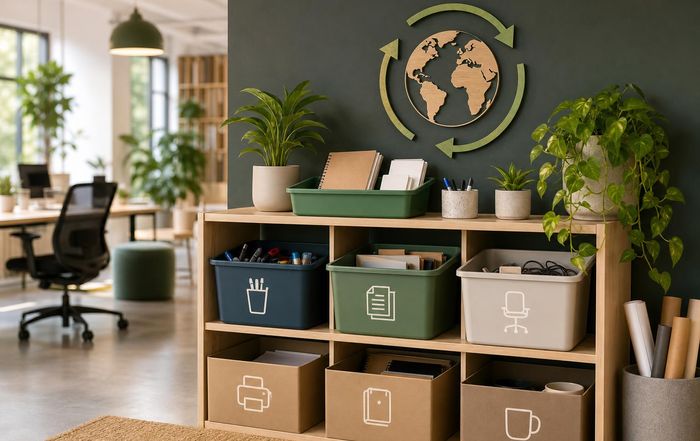
Use simple, modular furnitureSturdy shelving, a small cabinet, or a repurposed bookcase is usually enough. Avoid flimsy cardboard boxes that quickly look messy. If possible, use second-hand furniture to embody the reuse message itself. Organizations like Habitat for Humanity ReStores at https://www.habitat.org/ and local reuse centers can be good sources of used shelving in some countries.
Create clear categoriesGroup items logically: "Notebooks and paper," "Files and binders," "Desk accessories," "Cables and peripherals," "Miscellaneous." Use large, legible labels. This reduces rummaging and makes it easier to see when a category is overflowing or empty.
Prioritize visibilityKeep items at eye level where possible and avoid deep, dark shelves. Transparent containers can help with smaller items like pens, clips, and cables. The goal is that someone can scan the station in seconds and see whether there's something they can use.
Add simple, friendly signageA prominent sign should state the name (e.g., "Reuse Station," "Share Shelf," or "Resource Library") and one-line purpose: "Drop off surplus office supplies; take what you need." Visual icons or a short explainer about the environmental benefits, referencing credible sources like the UN Environment Programme at https://www.unep.org/ or the Ellen MacArthur Foundation at https://ellenmacarthurfoundation.org/, can reinforce why it exists.
Keep it clean and tidyA cluttered station quickly discourages participation. Plan for regular tidying, dusting, and removal of unsuitable items. This is not just aesthetics; it signals that the station is actively managed and endorsed, not abandoned.
Where possible, align the station's look and feel with your office design and design guidelines. If the office is carefully curated but the reuse station looks like a garage sale, people may subconsciously avoid it. A small investment in consistent signage, branded labels, or color-coded bins can go a long way.
Decide What to Include-and What to Exclude
Curating the scope of your reuse station is essential to keep it manageable and safe. Start with a limited, low-risk set of items and expand later if it works well.
Commonly included items:
Stationery: pens, pencils, markers, highlighters, staplers, hole punches, scissors.
Paper products: notebooks, notepads, sticky notes, unused envelopes, index cards.
Filing and organization: ring binders, lever arch files, document wallets, trays, magazine files.
Desk accessories: pen pots, monitor stands (non-adjustable), cable organizers, mouse pads.
Office "swag": unused branded notebooks, mugs, lanyards, tote bags.
IT-approved low-risk items: standard power cables, VGA/HDMI/USB adapters, mice, keyboards, provided your IT or safety teams have signed off.
Items best excluded or tightly controlled:
Broken or unsafe items: damaged electronics, cracked plastic, sharp edges.
Anything with data: USB sticks, hard drives, phones, laptops. These should go through formal IT asset disposal or refurbishment channels, following guidance from organizations like NIST at https://www.nist.gov/ or equivalent national bodies.
Confidential or branded documents: old reports, printed presentations, or anything with personal data should go directly to secure shredding or confidential waste.
Personal items: clothing, shoes, food, cosmetics, medicine. These can raise hygiene and HR issues.
Furniture and large items: chairs, desks, large screens can overwhelm the station. Manage them through a separate process or digital "internal marketplace."
Make the inclusion/exclusion list public on a sign and in a short internal guide. If your company operates across multiple countries, check local health and safety rules or fire codes; regulators such as the UK Health and Safety Executive at https://www.hse.gov.uk/ or Safe Work Australia at https://www.safeworkaustralia.gov.au/ may have relevant guidance on storage of materials, electrical equipment, or trip hazards.
Build Reuse Into Everyday Office Processes
A reuse station works best when it is integrated into existing workflows rather than treated as an optional extra. That means deliberately connecting it to procurement, onboarding, moves, and clear-outs.
Link it to ordering and procurementBefore staff order new supplies, encourage them to "check the reuse station first." This can be built into procurement forms or purchasing portals: a simple reminder line or checkbox is often enough. Facilities or purchasing teams can track orders of common items (binders, folders, pens) and periodically check whether the station holds surplus equivalents.
Integrate with office moves and refurbishmentsOffice moves, team reshuffles, and refurbishments generate large amounts of surplus equipment and supplies. Build a step into move-out checklists where teams sort items into "reuse station," "donate externally," and "recycle or dispose." The EPA and similar agencies emphasize reuse and donation as preferred routes for office furniture and equipment; a station can capture smaller items that are otherwise overlooked.
Include in onboarding and trainingNew starters are a prime audience: they often need basic supplies and are forming habits. Mention the station in induction sessions, and show a photo or map. This is a low-effort way to embed reuse into company culture from day one, alongside other environmental awareness initiatives.
Coordinate with IT and facilitiesFor any tech-related items, agree a simple process with IT: which items can be freely reused, which require testing, and which must go through formal asset management. Similarly, facilities can set guidelines on maximum quantities, storage safety, and what to do with overflow.
Align with your wider sustainability strategyIf your organization reports on climate change or circular economy goals, the reuse station can contribute qualitative stories and, in some cases, quantitative data (e.g., number of items reused, rough value saved). External frameworks like the Global Reporting Initiative at https://www.globalreporting.org/ and the CDP at https://www.cdp.net/ encourage disclosure on resource efficiency and waste reduction; internal reuse initiatives can support those narratives.
Make Participation Easy and Socially Acceptable
Even the best-designed station fails if people feel awkward using it. In many workplaces, there is a subtle stigma around taking "used" items or being seen as "cheap." Overcoming that is as much about culture as it is about logistics.
Normalize taking as well as givingEmphasize that the station is for everyone, and that taking items is as valuable as donating them. The environmental impact comes from avoided purchases, not just from cleared cupboards. Messaging like "Take what you need, leave what you don't" or "Rescue supplies before they become waste" reframes participation as positive.
Get leadership to model behaviorWhen managers or senior leaders visibly use the station-mentioning it in meetings, sharing a photo of a reused item on the company chat-it signals that reuse is endorsed, not a sign of penny-pinching. Sustainability teams can coach leaders on how to talk about it in a way that feels authentic rather than performative.
Use gentle prompts and storytellingShort stories or photos of "rescued" items can be surprisingly powerful: a pile of binders that found a second life in another department, or a stack of branded notebooks from an old campaign now used for training sessions. Internal communication channels-newsletters, intranet posts, or digital signage-can feature occasional "reuse wins" alongside broader global sustainability news from sources like the UNEP or World Resources Institute at https://www.wri.org/.
Respect professional aestheticsSome staff, especially in client-facing roles, may worry that reused items look scruffy. Mitigate this by maintaining quality standards: only clean, presentable items; damaged or heavily marked items go to recycling. For branded materials, ensure logos are still current to avoid confusion.
Avoid shamingDo not call out teams that throw away supplies or individuals who prefer new items. Shaming tends to backfire. Instead, highlight positive examples and the tangible benefits-such as budget savings that can be redirected to team activities or personal well-being programs.
Establish Light-Touch Management and Metrics
A reuse station does not need to be labor-intensive, but it does need some stewardship. Without it, quality declines, and people lose trust.
Assign a responsible ownerThis could be a facilities manager, a sustainability officer, or a small "green team." Their role is to check the station regularly (weekly is usually enough), remove unsuitable items, and coordinate communication. In some organizations, volunteers rotate this duty, which can strengthen engagement.
Set simple routinesTypical recurring tasks include tidying shelves, consolidating half-used categories, recycling damaged items, and occasionally re-labelling bins. For overflow, define a threshold (e.g., "no more than X binders") and a plan: donate to local schools or charities, or send to specialized recyclers. Networks like Zero Waste Europe at https://zerowasteeurope.eu/ or national reuse platforms can point to local partners.
Track basic indicatorsYou do not need a sophisticated system, but some light measurement can demonstrate value:
Periodic counts of high-volume items (e.g., how many binders or notebooks are taken over a quarter).
Rough estimates of cost savings using average purchase prices.
Qualitative feedback from staff surveys or suggestion boxes.
These metrics can feed into broader business sustainability reporting and help justify the small time investment. They also show whether adjustments are needed-more promotion, different location, or tighter curation.
Connect data to climate and resource goalsIf your organization tracks carbon emissions or material use, you can approximate the avoided impact of reused items using generic emission factors from bodies like the International Energy Agency at https://www.iea.org/ or lifecycle databases. Even if estimates are rough, they help link daily office practices to global environmental issues.
Adapt for Hybrid, Global, and Digital Workplaces
Many organizations now operate across multiple sites and time zones, with hybrid or remote work patterns. Reuse stations can still work in this context, but they may need adaptation.
Multiple sites, consistent principlesFor global companies, it often makes sense to define a simple global framework-purpose, core rules, and branding-while allowing each site to adapt details (location, categories) to local context and regulations. Facilities leads can share good practice across sites and align with local waste laws, which vary widely between countries.
Hybrid work and fluctuating occupancyIf offices are only busy on certain days, time communications to those peaks. For example, promote the station on days when most teams are in, or align tidy-ups with "anchor days." Consider pairing the physical station with a simple digital inventory: occasional photos posted in a channel like "#reuse-station" can remind remote workers to check it when they next come in.
Digital "reuse boards" for larger itemsFor bulky items or equipment that cannot sit on a shelf, a digital noticeboard or internal marketplace can complement the physical station. Staff can post items available in their area, with simple rules and time limits. This approach aligns with broader innovation in internal collaboration tools and can be particularly useful in large campuses.
Cultural differencesAttitudes to second-hand items and sharing vary across cultures. In some regions, reuse is strongly normalized; in others, it may carry stigma. Local champions-people who understand workplace culture in each country-are best placed to tailor messaging and practices. International organizations can draw on resources from bodies like the ILO at https://www.ilo.org/ or OECD at https://www.oecd.org/ to frame reuse as part of responsible business conduct rather than a cost-cutting measure.
Linking Reuse Stations to a Broader Sustainability Story
A well-run reuse station is a small but visible piece of a larger sustainability puzzle. It connects directly to themes of sustainable living, waste reduction, and sustainable business, and it can help bring otherwise abstract climate and circular economy commitments to life in the workplace.
To maximize that impact:
Position the station alongside other initiatives-recycling streams, energy-saving campaigns, low-carbon commuting programs-so staff see a coherent strategy rather than isolated projects.
Use stories from the station in sustainability reports, town halls, and training to illustrate how everyday actions support big goals.
Periodically review and refresh the station's design and communication so it does not fade into the background.
Ultimately, the most successful reuse stations are those that feel like a natural, useful part of office life. When people instinctively check the shelf before ordering new supplies-and feel good about doing so-the station has moved beyond a sustainability symbol to become a quiet engine of resource efficiency.
