
How Technology Helps Track Climate Impact
The New Climate Intelligence Era
You cannot say you haven't noticed climate action has moved decisively from aspiration to accountability, and nowhere is this shift more visible than in the rapid evolution of technologies that measure, monitor, and verify environmental impact in real time. For the environmentally up-to-date community that gathers around YouSaveOurWorld, the question is not whether technology can help track climate impact, but how organizations, communities, and individuals can harness this new climate intelligence to transform sustainable living, responsible business, and personal well-being into measurable, verifiable outcomes rather than vague intentions.
As climate risks intensify and regulatory expectations grow more stringent, the ability to quantify emissions, resource use, and ecological impacts with precision has become a strategic necessity for enterprises and a practical tool for households. Digital systems now underpin everything from Scope 3 supply-chain accounting to household energy dashboards, and the organizations that master these tools are finding that robust climate data not only reduces environmental harm, but also strengthens competitiveness, resilience, and trust with stakeholders. This article explores the technologies that have become central to tracking climate impact in 2026, and explains how the audience of YouSaveOurWorld.com can integrate them into sustainable living, plastic recycling, sustainable business, and climate-conscious lifestyle choices.
From Estimates to Evidence: Why Measurement Matters
For decades, climate reporting was dominated by estimates, assumptions, and sector averages, which often obscured real performance and made it difficult to distinguish genuine progress from greenwashing. As financial markets, regulators, and civil society demanded more reliable information, climate tracking technologies evolved to deliver granular, time-stamped, and location-specific data that could withstand scrutiny. Institutions such as the Intergovernmental Panel on Climate Change (IPCC) have repeatedly emphasized that accurate emissions inventories and transparent monitoring are foundational to effective mitigation and adaptation, and this scientific consensus has increasingly shaped business and policy expectations worldwide. Learn more about the scientific basis of climate tracking at the IPCC official website.
On YouSaveOurWorld.com, this shift from rough estimates to evidence is reflected in the growing interest in data-informed approaches to climate change and environmental awareness. When individuals and organizations can see the quantified effect of their choices-how much carbon is avoided by switching to low-carbon materials, how much plastic is diverted from landfills through recycling, or how much energy is saved by building redesign-sustainability stops being an abstract moral imperative and becomes a practical, trackable performance objective. This data-driven clarity is now central to credible sustainability strategies and to the emerging discipline of climate risk management across the global economy.
Satellites, Sensors, and the Rise of Planetary Monitoring
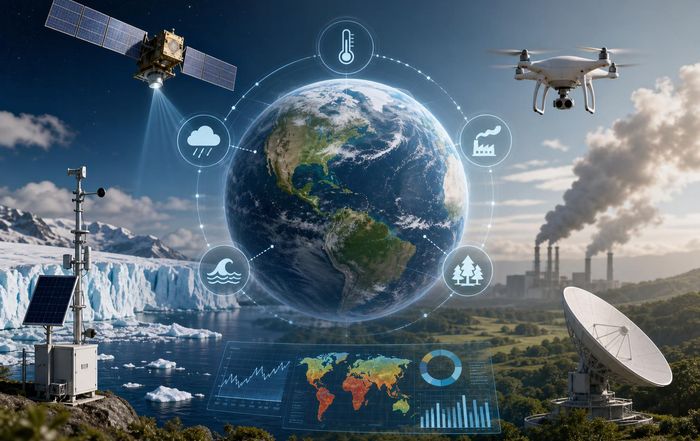
One of the most transformative developments of the past decade has been the integration of space-based observation and terrestrial sensor networks into a cohesive planetary monitoring system. Organizations such as NASA, the European Space Agency (ESA), and the European Union's Copernicus Programme now provide continuous, high-resolution data on greenhouse gas concentrations, land-use change, deforestation, and ice-sheet dynamics, enabling scientists, governments, and businesses to monitor climate-related changes with unprecedented precision. Explore global Earth observation data through the Copernicus Open Access Hub and learn how satellite monitoring informs climate decision-making at NASA's climate portal.
These satellite data streams are increasingly complemented by ground-based sensor networks that track local air quality, urban heat islands, water levels, and biodiversity indicators. Municipalities, utilities, and private firms deploy Internet of Things (IoT) devices to monitor energy use, emissions from industrial stacks, methane leaks from pipelines, and even soil moisture in agricultural fields. This fusion of macro- and micro-level observation creates a multi-layered view of environmental conditions that can be integrated into climate models, regulatory systems, and corporate sustainability platforms. For the global audience of YouSaveOurWorld.com, this technology underpins many of the tools that now inform local climate adaptation plans, sustainable urban design, and data-driven environmental education.
Artificial Intelligence and Climate Analytics
The sheer volume of climate-related data generated by satellites, sensors, and digital systems would be unmanageable without advanced analytics and artificial intelligence. By 2026, AI and machine learning have become central to extracting actionable insights from climate data, enabling stakeholders to move beyond static reporting toward predictive and prescriptive analysis. Institutions such as The Alan Turing Institute and MIT have invested heavily in climate-focused AI research, advancing methods that can detect subtle environmental patterns, forecast extreme weather, and attribute emissions to specific activities or facilities. Learn more about AI and climate at the MIT Climate Portal and explore data science applications in sustainability through the Alan Turing Institute.
In the business context, AI-driven platforms now integrate emissions data from energy bills, logistics systems, procurement records, and production lines to generate near real-time carbon ledgers. These systems help companies identify high-impact abatement opportunities, optimize supply chains, and simulate the effects of different decarbonization strategies. For communities interested in sustainable business and innovation, AI-enabled climate analytics provide a powerful foundation for setting science-based targets, designing low-carbon products, and aligning operations with emerging regulatory frameworks such as the International Sustainability Standards Board (ISSB) climate disclosure requirements. Further guidance on climate-related financial disclosures can be found through the IFRS Foundation.
Digital Twins and Scenario Modeling for Climate-Resilient Design
Another transformative technology now shaping climate impact tracking is the use of digital twins-virtual replicas of physical systems that are continuously updated with real-world data. In 2026, digital twins are widely deployed in buildings, industrial facilities, transportation networks, and even entire cities to simulate how different interventions will affect energy use, emissions, and resilience under various climate scenarios. Organizations such as Siemens, Microsoft, and leading smart-city developers have pioneered digital twin platforms that allow engineers and planners to test alternative designs, materials, and control strategies before making physical changes, thereby reducing both risk and cost.
For the audience of YouSaveOurWorld.com, digital twins are particularly relevant to sustainable design, green building, and low-carbon infrastructure. Architectural firms can use building information modeling (BIM) combined with real-time sensor data to track operational energy performance, while city planners simulate the impact of green roofs, tree planting, and reflective surfaces on urban heat and stormwater management. Global initiatives like C40 Cities showcase how metropolitan regions are using such tools to align urban development with net-zero goals and climate resilience strategies; more details are available on the C40 Cities website. This convergence of design, data, and climate science allows decision-makers to quantify the benefits of sustainable interventions and to communicate these benefits transparently to investors, regulators, and residents.
Corporate Climate Accounting and ESG Integration
Tracking climate impact has also become a central component of corporate governance and financial reporting. As environmental, social, and governance (ESG) expectations have matured, companies are now expected to provide verifiable emissions data across their entire value chains, including hard-to-measure Scope 3 categories such as purchased goods, business travel, and product use. Standards developed by the Greenhouse Gas Protocol, the Science Based Targets initiative (SBTi), and the Task Force on Climate-related Financial Disclosures (TCFD) have driven a wave of investment in climate accounting platforms that integrate data from enterprise resource planning systems, logistics networks, and supplier portals. Learn more about corporate GHG accounting at the Greenhouse Gas Protocol and explore science-based target setting through the SBTi.
For businesses engaging with YouSaveOurWorld.com through its business and economy content, these technologies are no longer optional enhancements but essential infrastructure for maintaining market access, investor confidence, and regulatory compliance. Many leading companies now integrate climate metrics into executive compensation, capital budgeting, and product development, using technology platforms to track performance against net-zero roadmaps and to ensure that sustainability claims are grounded in auditable data. This level of accountability not only strengthens trust with stakeholders but also helps organizations identify cost-saving efficiencies in energy use, materials, and logistics, demonstrating that robust climate tracking supports both environmental and financial performance.
Technology and the Circular Economy: Waste and Plastic Tracking
As attention has shifted from linear "take-make-dispose" models to circular economy strategies, technology has become indispensable for tracking material flows, particularly in areas such as waste, packaging, and plastic recycling. Smart waste management systems now use sensors, RFID tags, and computer vision to monitor collection rates, contamination levels, and recycling outcomes, enabling municipalities and businesses to optimize routes, improve sorting, and reduce landfill dependency. Organizations like the Ellen MacArthur Foundation have been instrumental in promoting circular economy principles and showcasing digital tools that support material tracking and circular design; more information is available at the Ellen MacArthur Foundation website.
For the community of YouSaveOurWorld.com, which has a strong focus on plastic recycling and waste, these technologies help bridge the gap between intention and impact. Digital platforms now allow companies to trace the origin and destination of packaging materials, verify recycled content, and monitor the environmental benefits of design changes such as lightweighting or reusable formats. Computer vision systems deployed in sorting facilities can distinguish between different plastic types with high accuracy, increasing recovery rates and improving the economics of recycling. At the consumer level, apps linked to product barcodes or QR codes provide information on recyclability and environmental footprint, helping individuals make more informed purchasing and disposal decisions and aligning everyday lifestyle choices with measurable climate outcomes.
Empowering Sustainable Living Through Consumer Technology
While much of the public discussion about climate technology focuses on large-scale systems and corporate reporting, some of the most significant behavioral shifts are emerging from tools that help individuals track and reduce their personal environmental footprints. In 2026, a growing ecosystem of consumer apps, smart home devices, and wearable technologies enables households to monitor energy use, mobility emissions, and resource consumption with a level of detail that was previously available only to specialized researchers. Smart thermostats, connected appliances, and energy management platforms provide real-time feedback on electricity use and associated emissions, often linked to grid carbon intensity data. Learn more about household energy efficiency and climate impact at the U.S. Department of Energy and the International Energy Agency.
For visitors to YouSaveOurWorld.com who are exploring sustainable living and climate-conscious lifestyle choices, these technologies translate complex climate science into practical daily actions. Mobility apps can calculate the emissions of different transport options, nudging users toward public transit, cycling, or electric vehicles, while diet-tracking platforms now incorporate carbon and water footprints of food choices, encouraging shifts toward lower-impact diets. Personal carbon footprint calculators, when connected to bank transaction data or smart meter readings, provide more accurate estimates than generic online tools, and some financial institutions now integrate these insights into green banking products. This digital ecosystem supports a form of environmental self-awareness that aligns with broader personal well-being, as users experience the psychological benefits of acting consistently with their values and seeing tangible progress toward their climate goals.
Education, Awareness, and Climate Literacy Platforms
The acceleration of climate technology would be incomplete without parallel advances in climate education and public awareness. In 2026, digital learning platforms, virtual reality experiences, and interactive climate dashboards play a crucial role in translating complex data into accessible narratives for students, professionals, and the general public. Universities, NGOs, and intergovernmental organizations have developed open-access courses and tools that explain how climate models work, how emissions inventories are constructed, and how adaptation strategies can be evaluated. Prominent initiatives from UNESCO and UN Environment Programme (UNEP) have helped integrate climate literacy into formal curricula and lifelong learning programs worldwide; more resources can be found at the UNESCO climate change education page and the UNEP website.
For YouSaveOurWorld.com, which is committed to advancing education and environmental awareness, these technologies offer powerful tools to engage audiences with diverse backgrounds and levels of expertise. Interactive maps that visualize temperature anomalies, sea-level rise, or air quality trends enable users to explore climate impacts in their own regions, while gamified platforms encourage learners to experiment with mitigation strategies and see their modeled effects over time. Business leaders can access specialized training on climate risk disclosure, sustainable finance, and low-carbon innovation, while educators can draw on rich multimedia content to make climate science tangible for younger generations. This convergence of technology and education is essential to building the informed, empowered citizenry needed to sustain climate action over the long term.
Global Coordination, Standards, and Trust
As climate tracking technologies proliferate, the question of trust becomes central: who verifies the data, how comparable are metrics across regions and sectors, and how can stakeholders distinguish robust methodologies from superficial claims? In response, global institutions and standard-setting bodies have intensified efforts to harmonize climate reporting frameworks, data protocols, and verification practices. Organizations such as the United Nations Framework Convention on Climate Change (UNFCCC), the World Resources Institute (WRI), and the International Organization for Standardization (ISO) have played key roles in defining consistent approaches to emissions accounting, climate risk assessment, and environmental management. Further information on global climate governance is available from the UNFCCC and on environmental standards at the ISO website.
For the globally oriented community of YouSaveOurWorld.com, which regularly engages with global climate developments and cross-border supply chains, these standards underpin the credibility of climate tracking technologies. They ensure that emissions reductions claimed in one jurisdiction can be meaningfully compared with those in another, and that climate-related financial products are based on reliable underlying data. Independent verification bodies and third-party auditors increasingly rely on digital tools to cross-check reported emissions against satellite observations, energy consumption records, and supply-chain data, creating a multi-layered assurance system. This emphasis on standardized, verifiable information strengthens the overall architecture of climate governance and helps align technological innovation with the core principles of experience, expertise, authoritativeness, and trustworthiness that are central to the mission of YouSaveOurWorld.com.
Integrating Technology Safely into Strategy for The Long Road Ahead
Technology has firmly established itself as the backbone of some climate impact tracking, but the full value of these tools depends on how effectively they are integrated into decision-making at every level, from corporate boardrooms to municipal councils to individual households. For businesses, this means embedding climate metrics into core strategy, capital allocation, and product development rather than treating them as peripheral reporting obligations. For cities and regions, it involves using real-time environmental data to guide urban planning, infrastructure investment, and public health initiatives. For individuals and communities, it calls for embracing digital tools that support sustainable choices in energy, mobility, consumption, and waste management, and for sharing experiences and insights through digital locations like YouSaveOurWorld.com.
As the earth caring people on YouSaveOurWorld continues to explore the intersections of technology, innovation, economy, and climate action, the central challenge will be to move beyond fragmented initiatives toward integrated, system-level transformation. Climate tracking technologies provide the data and analytical power needed to understand where emissions arise, which interventions are most effective, and how progress can be verified transparently. The next phase of climate leadership will be defined by those who not only deploy these tools, but who also cultivate the organizational capabilities, governance structures, and cultural commitments required to act on the insights they provide.
In this emerging landscape, YouSaveOurWorld.com serves as a bridge between cutting-edge technological developments and practical application across sustainable living, responsible business, and global climate stewardship. By curating knowledge, highlighting best practices, and connecting a diverse community of practitioners, educators, and citizens, the site helps ensure that climate tracking technologies are not confined to technical specialists, but become accessible instruments of collective progress. As climate risks continue to evolve, this combination of robust technology, informed strategy, and shared commitment will be essential to safeguarding both the planet and the well-being of the people who depend on it.
